Weirdly, I found a Joy Harjo interview in a recent edition of AARP Bulletin. What a great discovery! Near the end of the piece, she says, “My sense is that when a child is born, mother’s milk emerges to feed the baby, but grandparents feed babies with stories.”
I got two things out of that statement. One is that, Yes! Indeed! I have been a grandparent now for almost 20 months. I plan to live another 20 years at least so that I can download all the stories I know about our grandson’s (and, hopefully his siblings and cousins) family. That role is particularly poignant for me because I am adopted and I am (as is he) a mixture of a half dozen family connections and a blend of
at least 10 different ethnicities. Plus, I only learned definitively of a big chunk of that mixture after I turned 45. No question, I want that kid to know as much as possible in his childhood about all the families that came together in order to wind up with him.
The other thing I get out of Harjo’s notion of feeding babies stories is the obvious one for any writer who makes it to the last quarter of life with their mind relatively intact and still creative: In the end, everything comes down to the stories told.
Writer’s of any age worth their beans understand the need to be as honest as possible about transcribing the meaning of life that they have discovered. Also, all the little doo-dads and fiddle stick facts that they have learned. Legitimate attempts at honesty and real meaning in any story produce reflections in the minds of readers and listeners that trigger all sorts of thinking and new ideas. Joy Harjo’s words, for instance, sparked and glinted all over my mind as I read that brief interview and realized the new reality that comes as I approach my 70s. There is something essential to how we carry so much memory here at this point of life and closer to our endings. Hopefully, too, we have learned useful lessons to pass on.
Circling and Power
Joy Harjo is one of America’s most important contemporary poets and a member of the Muscogee (Creek) Nation. She was Poet Laureate of the United States for three terms from 2019-2022. She has published 11 volumes of poetry and produced 7 award-winning albums of music. She is also the inaugural Artist-in-Residence at the Bob Dylan Center in Tulsa, Oklahoma. Her latest book is a memoir, Girl Warrior: On Coming of Age (W.W. Norton, 2025, 176 pp.).
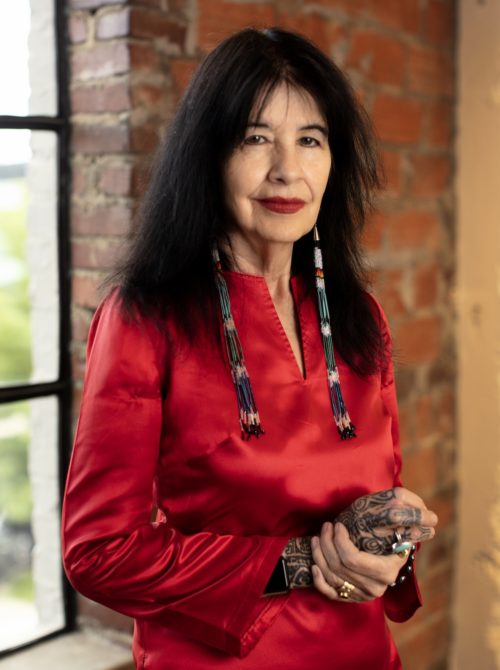
This is an era where paying attention to Native People and their connection to the land we all live in should carry significant weight for all of us. We all know the complexity and confusion of American history, and the hypocrisy and selfishness of many of the people who arrived here in this New World essentially beginning in the 1500s then moving all the way forward to now. We know as well of the violence, mayhem, and cruelty that went into defining our collective 500 years of history. Certain people seem always to attempt to cover over that history. They seek to re-program fellow citizens into believing in magical thoughts about how we all got here and how marvelous this country is and without a dark side. The truth, of course, continues to spike through the myths and fairy tales – even now as a strange group of hostile and angry Americans attempt to deploy their new approach to violence, mayhem, and cruelty.
In her interview, besides her wisdom about grandparent stories, Harjo also speaks to how this country can move forward. The Native way is more about consensus and less hierarchical. “You sit in a circle,” she points out. “Power has to do with acts of kindness.”
That circle concept is something we all know from school. Often times, too, versions of circle discussions can be found in workplace meetings and board rooms with tables that are more round than rectangular. A small detail, perhaps, but very telling even if bosses and managers and presidents are the leaders in the room.
“Power has to do with acts of kindness.”
But to me, the concept of sitting in a circle together goes further than the notion of egalitarian, non-heirarchical meetings and group decision making. We’re watching a bizarre and quite stupid group of frightened and hostile people all over the world attempting to force on all of us their frightened and hostile way of thinking. They apparently struggle to understand the ideas of empathy and cooperation. And so, lies, distortions, myths, and untrue stories are spread using the insanely simple technologies of 21st century communication in order to justify their fear and hostility. The problem there – and they are hyper aware of this even if they don’t know it – is that we all live together now. The United States population is nearing 350 million people and the world’s population is a bit over 8.2 billion. The world’s population will top 9 billion by 2037 and 10 billion by 2060. I was born in 1958. There were 174 million Americans back then, and 2.9 billion global citizens. Yes, we had phones and TVs and radios back in the day, but in the future it’s possible that children will be issued communication devices when they come home from the hospital after being born or have them implanted somewhere between their earlobes and the corners of their eyes.
The End of Anger
What does focused hostility do for anyone in the world? Where do you send people you don’t feel comfortable with? Why do you think you are rid of anyone ever? If you don’t have one group to hate, then there’s always eight or ten more. As well, there is the problem of people deciding to hate you back because of your cruelty and aggression. In order to implement hostility towards specific groups of people (and individuals), the implication is that you yourself are now in jeopardy of having others decide to be antagonistic towards you … which of course we all know pretty clearly is one very dominant stream of history for all of humanity.
However, the reality is that we’re still all sitting in a circle together. We didn’t really know that until this century. Now it is very clear–at least to some of us. Yes, we see what’s going on in Gaza and Ukraine and all over the world with migrants fleeing violence, the effects of global warming, and disastrous economic conditions caused by oligarchs and tyrants. We see as well in America that there is a large group of us who don’t like the ideas of sharing and taking care of each other. There has always been, for some of us anyway, a problem with the simple notion of trying to make things work better for everyone.
But we’re still all sitting in the circle together. The truth is that no one who attempts to lie and distort reality can be in charge. They may think they’re in charge and they may pay a vast number of underlings and sycophants to pretend they’re in charge. But they aren’t. We’re sitting in the circle together. Always together. Power is about kindness and support. Power in this modern world requires legitimate leadership and obvious concern for everyone. Power is about acknowledging the reality of life and its unbelievable vast mysteries, wonders, and complexities while we all sit together in the circle.
In her AARP interview, Harjo says “We’re all part of each other, walking the story.” Maybe the problem some people are still trying to work out is based on the fact, or the wish, that they aren’t part of the rest of us. Being together in the circle is not hard to understand. It’s just hard, maybe, to accept. There’s grave responsibility that comes from seeing everyone else together with you in the circle – grave responsibility, but also the possibility of great joy and vision. The question is not whether we’re all sitting together in the circle. The question is what’s in the middle? I kind of know what the answer is. So does Harjo. Do you?
Post photo credit: Post photo by Dorota Trzaska on Unsplash; Matika Wilbur (from Joy Harjo’s website)
For more from Joy Harjo: