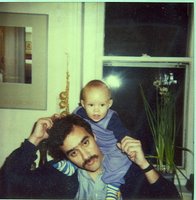
Photo to the left is me with my first-born son, Sam, circa spring 1989. What were we? Where did we come from?
August 15, 2003
We set off west for Richmond, Indiana and the traffic is like a line of cattle cars beginning in Philadelphia migrating all the way to Pittsburgh. I don’t remember the Pennsylvania Turnpike ever being so congested and dense with automobiles and trucks and people and confusion. The rest areas are a mass of humanity and smell of disinfectant, cash, body odor, new plastic, sugar drinks, and fried food. You are risking your life getting off this three hundred mile strip of highway to grab a snack and take a leak. Re-entering the road is like trying to attach your car to an alien freight train doing seventy-five, driven by thousands of desperate engineers.
I didn’t know why we were taking the trip, really. We had a name. That was all. In 1992 the state of Ohio created a process for adoptees born before 1970 to petition the state for their original birth certificates. I found out about this in 1996. It took me a year to work up the energy to obtain all the pertinent documents Ohio wanted me to file, but then I just let them all sit for another eighteen months after I discovered that I needed to send in a notarized form with copies of my social security card and driver’s license attached. I couldn’t find my social security card and didn’t have a copier, nor did I have the mojo required to apply to the Social Security Administration for a new card, go to Kinko’s, make the copies, and then walk half a block down the road from Kinko’s to our local AAA office where as a member I was entitled to one notarized signature a year. Finally, I just left the documents I had in an unmarked folder on the corner of my desk and forgot about them. Over the next year they were buried underneath other folders and magazines with articles I intended to read.
September 11, 2001 came along, though, and got me thinking about how limited life can be if you let things go. That day of insanity got a lot of us thinking about a lot of things. I knew several people who’d lost loved ones in the fall of the Twin Towers. They hold your gaze when you look at them, and make you feel that you need to do something with your life.
I spent a whole year thinking about my adoption and what it meant after that day. When you’re adopted you’re less than an accident—you don’t know the circumstances of your birth; your very conception seems to have come about by the snap of two fingers in the backseat of a car around 11:30 P.M. on a rainy Saturday night; and, in my case anyway, you have no idea what your racial or ethnic heritage is.
But on the first anniversary of that beautiful morning ushering us into the realities of the 21st century, I took the day off and pulled all my documentation together so that I could finally make the state of Ohio happy. Three months later I received a copy of my original birth certificate in the mail. My biological father” was registered as “Unknown,” but my birth mother’s name and even her address at the time of my adoption in 1958 were listed. I spent several days trying to track her down on the Internet, all to no avail. I used MapQuest to plot out the address given on the document. But cartoon maps are not very satisfying when you want answers to real questions. After a week or so of dithering, I put the document away again in the folder, but this time labeled it The Formality of Occurrence. It was a bright yellow folder and I hid it in the back of my file cabinet. The term was something I’d read somewhere. The formality of occurrence. When things happen they become formal; they move from what is possible to what is real. By formal I do not mean sophisticated or academic. I don’t mean that it is necessarily complex or something to be studied by science. The formality of occurrence is simply the recognition that something has happened, something beyond the five senses, something that is real to the mind and to our understanding. The formality of occurrence is the nexus of fate and individual existence. It is the answer to the question: “What if all of this is just a figment of my imagination? What if I’m just dreaming all of this? What if I’ve just made up all of you?” The formality of occurrence seemed to me the process whereby each of our realities becomes as real as every other possible reality that could have been; the process that makes one life no more worthy than another.
The formality of occurrence for my life, though, was incomplete because I was adopted. I was stuck in the infinity of possibility, a story with no beginning. Somehow, I felt that putting things in that yellow folder was the only way I could come close to filling my identity up with even a semblance of significance.
After that, I began to put everything I came across about adoption and racial identity in that folder: how people chart out their connections; all the articles I could find on Kevin Bacon and the five degrees of separation supposedly connecting our entire culture; little essays by famous writers on what it felt like to adopt a child; feature pieces on the dilemmas and joys of inter-racial adoption. I remember thinking that I had no idea what I was doing. I was just stuffing this file folder full of anything that seemed significant. I couldn’t even remember where I’d read about the formality of occurrence. I walked around for months with that term in my head, scanning magazines and the Internet for anything even remotely relevant to the notion of the story of lives and the fragile net of connection that we all seek all of the time, even if we’re not aware of our seeking. The phrase fell into my head once years before, but its origin at that time had dissipated into the ether. It just seemed like an appropriate title for a file folder that I intended to fill up with this almost useless information. I think I hoped that the accumulation of enough material would someday lead to a transformation–if not real, then at least something intellectual.
I put the official Ohio birth certificate away in that folder, then stuffed it in the back of my filing cabinet. I told no one about what I’d received in the mail. My birth mother’s name roiled around in my head after that, but it became almost frightening to consider her after awhile.
Her name was Dana Faith Black. The backup documentation to the certificate also gave the name of the baby–Anthony Tobias Black…me.
Like this:
Like Loading...


