I’ve been wondering about two things ever since the spring of 2016 when Donald Trump began winning primaries and getting all sorts of weird media attention. First off, were the Republican Party and its voters really willing to accept responsibility for the direction that guy wanted to push them? And, secondly, how much would the art world step up as a reaction to what Trump and his ilk seemed to want to do to our country?
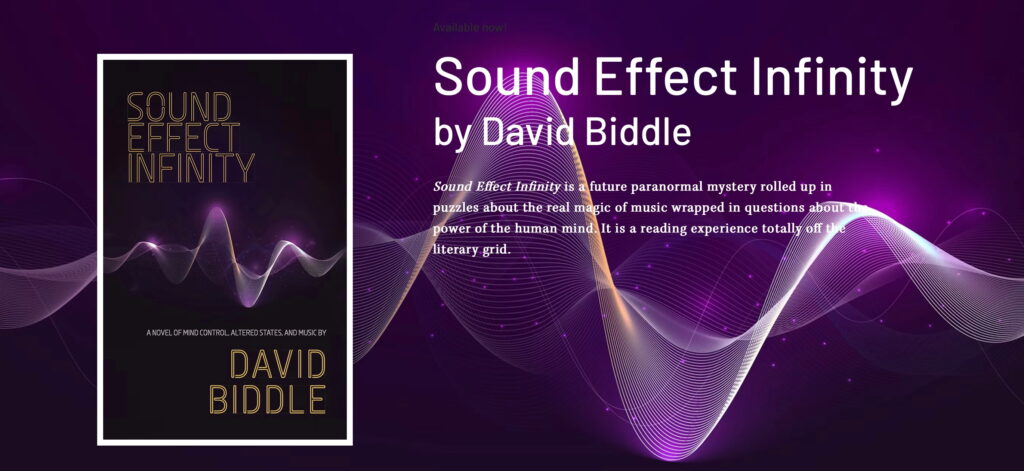
Special Note from the Future: My new novel, Sound Effect Infinity, should have been available as an E-book everywhere that digital books are sold, but it wasn't until now, here in 2026. Here's the landing page at Amazon now and for the rest of the spring of 2026.
Below is text from 2025. I have moved quite far since then. This is left here at my website for archival purposes only. My old publisher never really got things rolling for me, so this year (2026) we moved forward with Flat Branch Press. Below, you’ll find where I was in 2025 if you want some background on where I was in 2025. Where were you, by the way?
As to the spoken word version, I continue to slowly edit and correct the audio files. What an interesting and important process for all writers. I pointed that out in my last post. It continues to be a fascinating experience to hear someone else read my narrator’s words. Instead of revising and editing, the point is to ensure that they are replicated into voice as close to how they were written as possible. I’m hoping we’ll all see the audio version for sale by the end of March.
I wish the bound and printed version of this novel was already available, but the E-Book will have to do for now. I can breathe better with at least one version of this funky story out there. For those of you who “only read on paper,” may I suggest getting started on the E-book then converting over when it comes out in premium hardcover? Just a thought. Your support now will help immensely with internet algorithms when the printed version becomes available.
No matter what, I had been waiting far too long for any version release of Sound Effect Infinity. Yes, in part it’s a near-future science fiction dealing with the power of loud guitars and the magic of music all connected to secrets about CIA paranormal experimentation and remote viewing. But it’s also now kind of close to home in how it describes the way America’s political life seems to be floating off into strange new sections of our national cosmic river.
For the record, Sound Effect Infinity began as an attempt to write something intelligent but wild and crazy about sex, drugs, and rock ‘n’ roll. So many whippersnappers out there still give my generation shit with their “Okay, Boomer…” assholery. But think about it: who invented sex, drugs, and rock ‘n’ roll as a philosophy and a way of life? And who now is inventing this bizarre shift of intelligence in our collective life here in the mid-2020s?
Boomers Rock Better Than Ever
As to that sex, drugs, and rock ‘n’roll phenomenon, I turn 67 in a few days and have been asking myself over the past several yearsl: “Would I go back and do things differently?” I want to believe I would. No question, you can never have enough sex when you’re below the age of 30, but the drug thing was rather debilitating after maybe that first 24 months or so in my teens. By my junior year of college, I had fully weaned myself off getting high every day by substituting whiskey highballs on Friday and Saturday nights only. But that’s still getting high, to be honest, and that habit rolled along first morphing into a regular, nightly unwinding (during the Reagan era) and lasting until I turned 50 when I finally understood the problem for what it was and began the long process of freeing myself from what really is a useless and emotionally poisonous addiction. It would take more than a decade to fully escape that prison.
So, yeah, booze can (and will) fuck you up. Not just as a drunk or functioning alcoholic, but in chronic emotional ways you aren’t even really making the right connection with. I may have written this in other places, but every counselor talking to couples in need of therapy should start by asking both parties to stop drinking and/or getting high in any way for a month before they come back for their second session. Sorry. But that’s totally true. Me? I’ve been 100% free of any kind of buzzy mindshift since November 2022.
As to the rock ‘n’ roll side of things, my generation gets an A+. No debate. Sorry. Music with a beat is now, in fact, one of the principle art forms worldwide, and by far and away the most personal and intimate sensual experience almost everyone has on a daily basis everywhere on the planet.
If you’ve learned the importance of the beat, you don’t even need to hear music in order to move in time to the Universe at large. One of the most touching video clips I saw on Instagram last year was three young boys, maybe 8 – 10, break dancing with joyous abandon in the middle of Gaza rubble. Bizarrely, the American press didn’t do a good job of covering this, but here’s an Australian outlet’s coverage of the phenomenon: This breakdance crew in Gaza is using dance to help children heal from trauma.
Rock music is in everything now, even what people call classical. And don’t get me wrong, Boomers didn’t invent rock. No one did. It probably came out of the ground first, but was in the air as well by 1948 or so, first, in places like New Orleans, Kansas City, and Chicago, but spreading fast everywhere – from London to Tokyo to Rio de Janeiro to Lagos to Dublin by 1962.
What Do You Think, Though?
Book promotion is going to be a major part of my 2025. The E-book edition of Sound Effect Infinity [was available but is available here in 2026, now, as a hardcover at Amazon…have I said that yet?]. Maybe it’s a new take on sex, drugs, and rock ‘n’ roll, maybe not. You’ll have to check it out.
Thus, here in the beginning of 2025 I’m partly sitting around waiting for people to read Sound Effect Infinity and tell the world what they think. Partially waiting as well for the hardcover release. Also hoping folks will just step up impatiently and buy the E-book while pre-ordering a copy of the printed version. You won’t be charged for that hard copy until it ships.
Next Book Up Is?
While I wait, I’m hard at work still on my next project, code named Notes on the Golden Country. I am up to the third and final section of that book which is part quest, part historical fiction, and part time travel science fiction. As with Sound Effect Infinity, this story is off the beaten path in all sorts of ways. I think it’s safe to say that as a kid who grew up in the ’60s and ’70s I’ve never found much value in canned or predictable attempts at storytelling. Notes on the Golden Country is all about America and somewhat rebellious in its plot and theme. (Is being rebellious an American trait?).
My writing has been kind of twisted into knots after last year’s election. I was surprised to see a majority of voters put the Republican Party in charge of this country. That still doesn’t compute. The choice was between love on one side and punishment on the other. Now it seems like it’s between dismay and destruction. Somehow, I’m finding ways to rise beyond all this shit. I have special secrets I’ve figured out and ways to avoid stepping in the piles of shit that are currently being dumped all over America by this group of foolish, incompetent wannabes.
Note that it was the majority of actual voters that put the Republicans in a position to shred government services and support, i.e., people who went to the polls. The reality is that the largest percentage of eligible voters did not vote. Once again, the winner of our national election was people who don’t understand or don’t think they should be required to give a shit. That wasn’t a surprise, but it was very sad since it was pretty obvious that a certain segment of political types have made it their business to suppress voting behavior and limit access to the polls. When people make things that obvious and are so openly cynical about what they’re doing and talk hatred, division, and punishment, it’s kind of a good idea to show them they’re being jerks at least by casting a vote on whether you agree or want a bit more common sense and humility leading the way for us all.
Looking People in the Eyes
I just finished writing an essay this afternoon that will be published soon. Near the end of it, I wrote: “I believe in peace, love, community, independence, laughing, looking people in the eyes, being honest, and working hard not to be angry or hateful towards anyone.” I try to get those perspectives into all of my work as best I can–my stories, social media posts, online commentary pieces, and the lyrics to music I’m working on. I have one song I’m almost happy with these days called “Discontented People,” and another called “Modern Crow Blues.” Also, I have the music fully composed but not the lyrics to a song I have decided to call “Dinner in the Air.” There are a lot of other ones in various stages of undress. I try to work on them carefully because I don’t want anger (rage?) guiding what I’m doing. Hopefully, those songs can actually be recorded and sent out into the world by this fall. Some of them are kind of good…or at least I’m happy with them. Happiness is important these days, right? Something to share? Buy the book and you’ll make me even happier…
I’ll leave off here now with a small quote from Sound Effect Infinity:
Even now, he gets inside each one of us. We feel it. We hear it. He moves us. But we don’t really think about what’s happening. It seems normal. Sound and feeling. Loud reverb music finds the actual human soul that each of us has whether we believe in that kind of thing or not.
I’m in the middle of writing a novel about 21st century racial identity, among other things. Also, pioneering, mixed race farming communities in the 19th century Midwest, and the future Utopia that we are all not going to know we’re living in. I began writing this story in the fall of 2003, partly as an experiment with a new-fangled thing called Weblogs. Also because after being on this planet for 45 years, I’d finally learned the secret of my biological heritage.
I was adopted in 1958. There were numerous “stories” about that adoption people told. But no one really knew anything besides the fact that I had dark features and looked like I came into the world as a blend of different types of people. No one ever really understood that I’d spent my life on the outside of DNA conversations. I felt left out and that I was missing something in life, but I also kind of felt superior to people who thought that stuff mattered.
That thinking went on way into my adult years. In the end, my wife and I decided we needed to somehow address the whole heritage thing as it pertained to me (she’s a locked down Irish-American lass). It seemed like good parenting to at least take a shot for an answer to the very real and intimate question: “Where did Dad come from?” Also, for that matter, “How did he get here?” In the case of blended adopted people like me, those are very visceral and poignantly simple questions that legitimately require an answer for one’s children.
So in 2003 we went searching for those answers. That was just as Ancestry.com was becoming a functional possibility for easy solutions to the question of DNA inheritance. A few years later I would actually take a spit-in-the-tube test.
But here’s the point of this hopefully quick essay: Yes, I was somewhat aware I could determine my ethnic heritage (note I do not say race because there is actually no such thing) using the test tube method, but I was also aware that taking a trip to the middle of the country where I began life might be an adventure that would change our family’s whole sense of who we are in the world.
That was all a bit more than 20 years ago. I’m not going to give away any answers here, except to say that we learned so much more than where I came from and why I’m here. It’s kind of a funny thing for someone like me to even think that my physical heritage really has much bearing on who I am as a person. Some might argue that being able to identify yourself as part of specific ethnic groups is a simple enhancement to the beauty of life.
I’ll let that last sentence percolate there for all of us here in 2024.
I was a fortunate little sprout growing up as a Biddle. My father was buddies with Coretta Scott during their first year at Antioch College in Yellow Springs, Ohio. They both loved music and were in classes and performances together. I was also raised in one of those weird, progressive families that periodically go to Friends Meeting when it’s convenient (or important) on a Sunday morning. Yup, we were Quakers (there’s a very long history for the Biddle family on that topic). I am proud of all that.
But what I want to close with here is that I was raised in a household where that oh so famous quote by Dr. Martin Luther King, Jr. wasn’t simply a nice thing to claim you believe in:
“I have a dream that my four little children will one day live in a nation where they will not be judged by the color of their skin but by the content of their character.”
–MLK, Jr.
I know it’s still a vision and a dream, but I feel that in our hearts every single American believes in that vision, especially those who are the most cynical about Dr. King’s statement. Everyone knows about that character idea and the problem with judging people we don’t know. We do it anyway, but we all know better. We really do!
In the end, the history of my DNA doesn’t really matter, not compared to all the people I’m connected to in my life and all the groups of which I am a part — from baseball fan and lover of improvisational music to half-assed Quaker and proud, loving citizen of my country and the world. I will always be on the outside looking in when it comes to DNA and biological heritage. Won’t that be funny someday when everyone has that same perspective?
Watch for the story I’m working on sometime near the end of 2025. It should be a wild read.
A version of this quick-read commentary was originally published by The Good Men Project as well as in their "Equality Include You" publication at Medium.com
[Note from 2026: A lot happened to prevent the proper publication of Sound Effect Infinity until February 2026, where this note is coming from. Click the links where you see them, and you’ll find the book posted to Amazon as a special edition hardcover offering. If you read below, you’ll see where things were, but not where they are now]
I already feel like a jerk. The only thing that is going to keep me from being selfish and single-minded here in 2024 is if I need surgery or get diagnosed with cancer or just don’t wake up some morning. A solid, working draft of my third novel for The Story Plant is due in December of 2024. The title we’re operating with right now is Notes on the Golden Country. I spent much of 2023 doing research and making notes for this year’s efforts. By late August I had started up on a first draft. As 2024 gets uncaged, I am about 120 pages in to Part I of three parts. I’m going to be a selfish jerk the rest of this year until I’m done. Meaning, I don’t want to come over to your house, go on a long walk, or anything else that will muddle my focus on writing this very odd story.
A version of this commentary was recently published at Medium.com in the Illumination publication collection
This week I’ve been reading an interview with nobel literature laureate Louis Glück in The Paris Review’s Winter 2023. It’s a great dialog conducted by esteemed poet, memoirist (and more), Henri Cole. Two poets talking, with one of them a recent nobel winner, is always interesting. For those of you who think this kind of thing snooty, high-falootin’, and/or elitist, sorry, but all the interviews in The Paris Review are fun to check out.
Seriously, we’re all writers these days. It’s useful to read the thinking of the world’s top practitioners. Their insights into process and intent can help with the most mundane written tasks. More importantly, though, writers–especially poets like Glück–tend to provide us with surprisingly useful insights into life. I offer a quick and simplified reason for this wisdom phenomenon from writers at the end of this piece.
To point, however: Deep in the interview, Henri Cole asks Louise, “Did you read poetry when you were a little girl?” That question struck loud even before I read her answer. Ever since I began writing Old Music for New People, I’ve been in search of thoughtful comments about identity and self-consciousness in this idiotic, ultra-modern world. The most important function of literature for the past century, in my opinion, has been to present us with a kaleidoscope of stories connected to people coming to terms with who they are in a world that seems a bit more predatory and judgmental than it should be.
Here, then, is Glück’s answer to Cole’s question about the idea of being a little girl:
“What’s odd in your question is the phrase “little girl.” I didn’t feel like a little girl — I would guess this to be a common feeling. I understood that I was perceived as one. I was certainly not a little boy. But I felt like a single, unprecedented thing, a mind, like the light a miner wears on their head. Adolescence, when it happened, was a shock. Suddenly I was inescapably confined by gender — I rejected this tacitly and also violently.”
Interview with Henri Cole, The Paris Review, vol. 246
“…a single, unprecedented thing, a mind…” Moving beyond reactionary politics and “correct speech” on all sides, that’s exactly what we are, even if we end up allowing the external world to absorb us. “Unprecedented.” Nothing more and nothing less, except perhaps the lights we make to wear on our heads.
Louise Glück died on October 13, 2023. She was 80. Surely, she was unprecedented most of her life. Every poet worth their beans is. But that’s also what each of us normal fools strives for … until, perhaps, we don’t. Which can be very sad.
Before signing off here, let me offer something to think about in 2024:
I wrote above that we’re all writers these days. That’s not hyperbole–certainly not with respect to anyone with a smart phone, laptop, or digital tablet. What is vital to understand about all the writing you’re doing is that when words in your mind get directly emblazened onto paper or liquid electrons in any way, your brain operates on a different level than when you speak. The same is true when you read, as opposed to simply listening to someone else reading to you.
It can be subtle at first, but writing and reading are intimate forms of consciousness and weirdly wired to the sub- and un-conscious parts of our minds. That can be quite dangerous, even ugly (think online trolls and angry anonymous rants). It can also be a wondrous and amazing thing, whether you’re writing to congratulate someone on getting into the college of their choice, attempting to out-poetify Louise Glück, or sending a passionate note to Taylor Swift or Carlos Santana.
Professional writers pay attention to this thing inside them that’s like a ringing bell tickling the brain in a certain way instead of making noise. When that bell activates, writers know they’re onto something. Everyone has that in them, you just have to pay attention and remain diligent in developing it. Like anything, if you pay attention and work hard you keep getting better at it. Reading great writers helps. In particular, reading interviews in The Paris Review can work wonders. I’m not going to get into the other side of the writing equation which is editing (and revising…endlessly), except to point out that the best writing is not intended to be wise or intriguing, it’s intended to be open enough so that readers have the opportunity to create wisdom and intrigue for themselves. Succeeding on that level is very difficult and requires lots or revising.
What I mean here as we head into a new year and life continues to be nearly completely out of control is that you could die next week. Now, hopefully, you have more insight into why writing and reading are vital to your existence.
Hopefully, too, you understand that you are “a single, unprecedented thing, a mind…” It’s the “unprecedented thing” that matters most. Don’t forget that.
A version of this essay was published in the Illumination publication on Medium several weeks ago.
These days, I wish as hard as I can for good things that are considered impossible to happen, like there actually being a Santa Claus with a whole team of people way up North who spend all year working on ways to gift the world with love and happiness and really cool new technology to boot. I also wonder sometimes whether we’ll be alive when the next truly artistic and creative musically gifted songwriters come along the way the Beatles did and don’t just change the course of music, but change the power of creativity and aesthetics for artists everywhere. I think and wish for that kind of stuff, because I firmly believe that envisioning amazing things is the only way we get beyond the malaise we’ve built for ourselves here in the 2020s.
I also wish people read and talked about utopian concepts more, and at least believed in the real possibility of more ideal societies. Whether we like it or not, the job of life will always be to build a better future for all of humankind. Note that italicized word there. It’s important.
My new novel, Sound Effect Infinity, will be released on January 23, 2024 (fingers crossed, because you never know about this world we all live in now). It’s a science fiction story about a near-future world where the mysteries of music and sound and human connection are front and center, along with mind control experiments of the CIA, and questions about the power of psychedelic drugs and paranormal phenomena. I’d say it’s worth the read just to see if the author can carry all that off.
I had a friend in junior high whose father and uncle decided they’d had enough of his long hair (beautiful, silken, golden wheat-colored, cascading well below his shoulders). They trapped him in the bathroom one Sunday night, held him against a wall, and shaved his head down to the skull. He showed up on our school bus the next morning ashen-faced and despondent — altered from an astoundingly beautiful young prince of the world into someone who looked and probably felt like an escaped convict.
This was in 1972. I grew up in the Midwest, where it was common for strangers to menacingly say: “Boy, you better cut your hair. You look like a girl.”
We talk a great deal about America as an experiment in democracy. An equally important metaphor about this “land of the free”is our nonstop, somewhat confused conversation about identity, especially with teenagers. No matter what adults believe, the major lesson virtually all young people come to terms with eventually is that there is no such thing as one answer to questions about who they are.
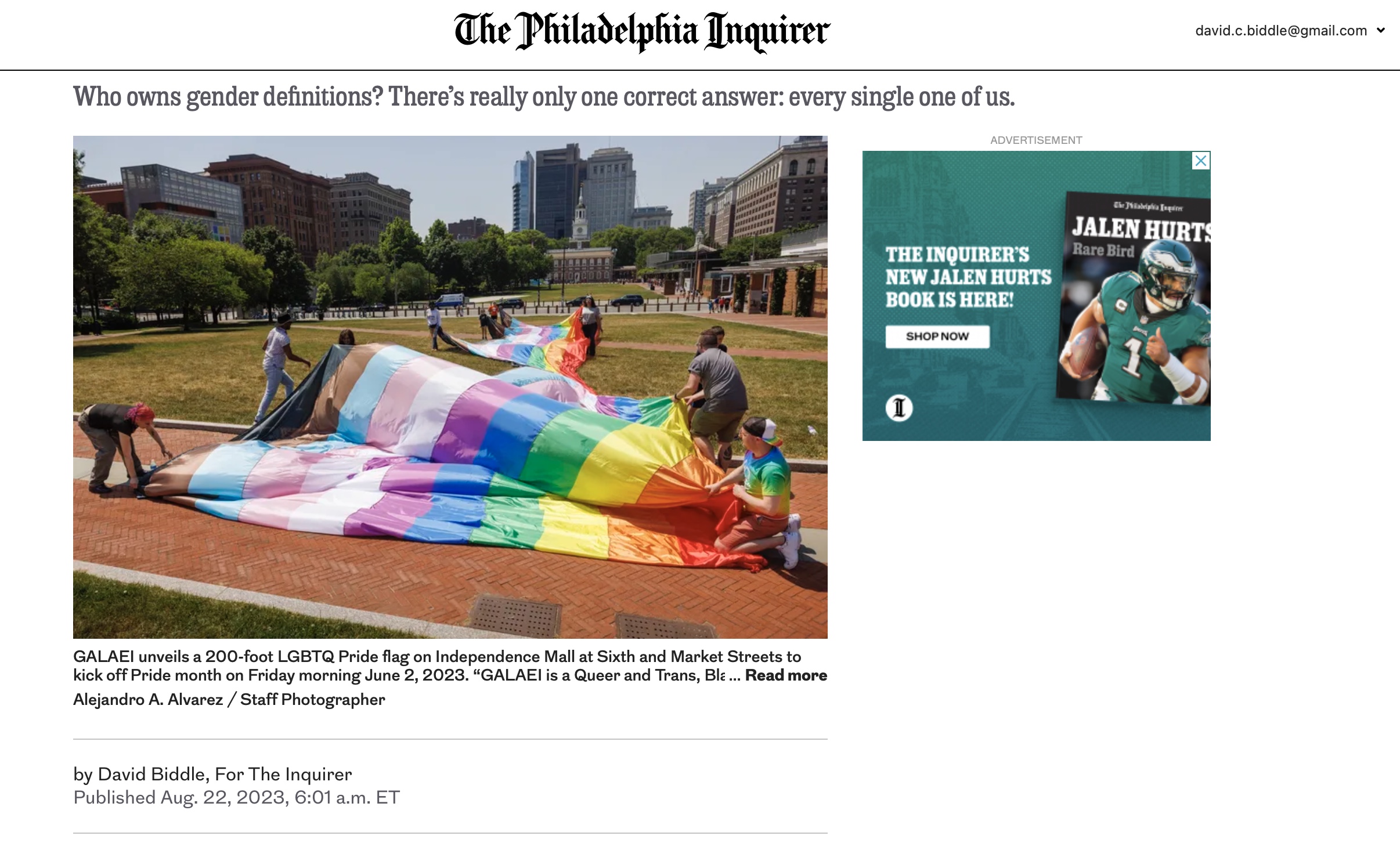
My essay, “Our National Conversation About Gender is One Big Miscommunication,” was published in The Philadelphia Inquirer a few weeks ago. I was fortunate enough to work on it with Commentary and Opinion Editor, Devi Lockwood. I am always grateful when my work goes through the fine-tuning filter of professional editors. I was quite happy with that piece when I submitted it. It says a lot more than pretty much anyone else has said on gender and identity in a long time (check it out if you don’t believe me). However, I wonder if people fully understood that I was pointing my finger at all of us and our growing collective inability to communicate in this nutso country, not just those who have demonstrated political and kneejerk prejudices about transgender culture.