R.I.P. Andy Griffith: You Did Something Very Special

I grew up watching the Andy Griffith Show several times a week. It ran from 1960 to 1968. We watched it when it was a prime time show and we watched it more once it became syndicated — probably from 1968 through 1980 three or four times a week in one way or another. Andy Griffith is deep inside my head. News today that he has died gave me a long pause and then a shiver. Without Andy, I don’t think I would have become the man I have become. Let me explain.

The parents of baby boomers have been called the greatest generation. I don’t want to debate that here, but I do want to say that while the fathers of the Greatest Generation had to face the Great Depression, World War II, the Korean War, the insanity of the Cold War, and a host of major civil rights issues, as a group they didn’t do a very good job being fathers. Many of them were emotionally distant, unyieldingly judgmental, and workaholics. Far too many of them also destroyed their families with booze, early death, or affairs with younger women. They were good men, but they were confused — or maybe it’s better to say they just didn’t know any better. Their fathers (our grandfathers) had also been troubled men. In the words of Kurt Vonnegut, one of the Greatest Generation, “So it goes.”
My generation of men, however, is the first generation that has had the benefit of self-actualized moms. We watched them become empowered in the 1970s (and deal with their husbands leaving them). And we also watched Andy. He presented a profound mix of manliness, intelligence, gentle humor, and — most importantly — a fearlessness when it came to empathy and emotional connection with everyone. As Sherif Andy Taylor, Griffith showed his son Opie (has there ever been a more lovable and innocent kid on the screen?) so much affection and love without ever giving up an inch of his masculinity. Even today it’s a marvel to watch Andy Griffith play that special character. He was the paw we all wanted. He was the dad we all knew we needed to become. And, I think, he was also the father that our own fathers wanted to be…but just had a hard time becoming. 
Griffith’s character didn’t just stop in his relationship to Opie. His best friend (cousin?) Barney Fife (played by the staggeringly hilarious Don Knotts) was a wimp and, essentially, an idiot. Besides getting himself into trouble, he was often a magnet for bullies and tough guys. Andy stepped in and pretty much always showed how you deal with that kind of jerk. Andy also demonstrated how to love and support other men who might not be as strong or confident — men who chatter like fools and act like idiots, but are good-natured and sweet nonetheless. His friendship with Barney was a pretty good template for all of us to follow.
Andy was, in fact, beloved by the whole town of Mayberry. He showed us how to be a compassionate leader without upsetting others who didn’t know any better. And the way he dealt with women — widower that he was — may well have ushered in the women’s movement a good decade before it would have come otherwise. Here was a man full of love, honesty, and integrity who respected the women of Mayberry almost to a fault. Here was the good soul that was hidden inside all the Boomer dads of America that women knew might step up if only their men weren’t so selfish and emotionally protective. 
The picture I paint here of our fathers is perhaps harsh. Things are never so black and white. There were certainly men in the 1960s — fathers — who knew how to show love and connect with their families. In some ways, I suppose, most men tried as hard as they could. I know my dad did. Maybe all Andy Griffith offered was the channeling of that desire most men had to be the perfect man, the perfect father. 
In the end, though, the generation of boys who grew up watching him be Andy Taylor were the ones who benefited the most. So many of my friends are now profoundly amazing dads, knowing how to show love and how to accept it. We, of course, have our own problems. But we each have Andy inside of us — even if we don’t know it — giving us permission to show compassion and empathy to our children, our wives, co-workers, and neighbors. We aren’t afraid to show emotion. We hug long and hard. And we even know how to talk about our feelings…sort of. Heck, even John Boehner isn’t afraid to cry in public. 
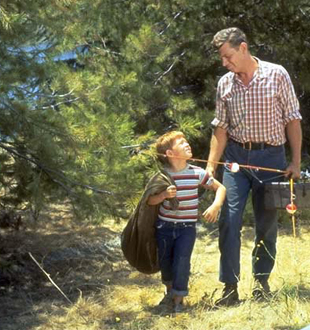
So, the loss of Andy Griffith should give all of my generation pause. There was no greater scene in our lives than the one that started and ended that show (as I remember it). Andy and Opie headin’ off to a fishin’ hole. Just the two of them, trundling like magpies through the woods. That was a scene I got to live (along with my brother) several times in my youth with my own dad. It didn’t happen enough, but it did happen. It never occurred to me until today that I got to watch it on TV five times a week for most of my early life and that in one way or another I’ve now lived out that scene with my own sons hundreds if not thousands of times in one way or another. 
Rest in peace Andy of Mayberry. You were an American treasure, and you shaped this country like few other actors ever have. You may be gone, but your Mayberry Soul is deep inside so many of us. It’s what gives me hope for America here in the 21st century. 

Paperback Rider: Beyond the Will of God, The Real Thing

Cover of the paperback, due out in July.

I’d originally planned on publishing a paperback version of Beyond the Will of God late in the fall. But within days of getting the word out to friends and family that they could download my book at the Kindle Store, it became astoundingly apparent (like a slap upside the head from my older cousin Danny) that there’s a huge portion of my world who still like to buy and read bound paper books.

Plus, never thought of it, but there’s certain people I want to make this book available to personally. I know even if friends are super iPad users (or whatever), they’re just not going to get to reading it unless Beyond the Will of God is sitting around their bedroom making them feel like it is, in fact, a real thing. I also need to go to the local bookstore in my neighborhood and give a copy to the owner. You don’t give e-books to bookstore owners.

A bound paper edition of Beyond the Will of God is therefore currently in production (under the Flat Branch Press imprint) and should be available for purchase in a week or so. You can see the draft book cover at the top of the page here. The hard copy will cost more than the digital version, but its likely at least some readers will find it a more familiar and cozy reading experience which is certainly worth the expense.
Important Indie Point and Lesson #9: The Paperback Rider
So, yeah, it may seem obvious now, but, if you’re really serious about your books, it probably makes sense to plan on producing both digital and paper versions of them simultaneously. Statistics I’ve read show that roughly 50% of the reading market use e-readers. The other 50% is more or less leery of moving down that road. Print-on-demand costs a bit to set up, and buyers have to pay more, but if half your market is non-virtual, you need to meet their needs…that includes your cousin Danny.

That said, I realize, too, that one of the problems with digital books is that no one can really see what you’re reading. The idea of a book cover is to advertise and create interest everywhere that book travels — the beach, train, picnics, whatever. Makes sense. Never thought of it so definitively until it became an issue that was personal.

I still highly recommend purchasing this book as an e-book now. It’s priced at $2.99. The paperback version will cost considerably more for obvious reasons, plus you will have to pay for shipping.

Also, check out my Amazon Author’s Page for my short story collection Trying to Care. These are straight ahead urban angst stories about mid-life love and confusion. Like life, they’re not about good and evil. They’re about you and me and all the people we know. Another collection called Implosions of America should be out before the end of the summer. When that hits the stores online, I promise it will be in both real and virtual renditions. Trying to Care should be out in paperback as well in a few weeks.

http://www.amazon.com/David-Biddle/e/B007BFDF22

Happy reading. Happy summer 2012.

-dcb

Burial of the Query Letter: Inside Beyond the Will of God

Somewhere in this photo is an envelope containing over 100 rejections.
You will find below an actual query sent earlier this year to a book publisher for my novel Beyond the Will of God. I sent out over 200 query letters for this novel — mostly in the early nawts. This is the very last one. I have an envelope, conveniently lost in my office now, with over 100 rejections of Beyond the Will stuffed into it. Yes, only about half the folks I reached out to actually made the effort Continue reading

Mind Maverick: Check out David Jay Brown

David Jay Brown covers the far edge of consciousness research. I stumbled into his work while reading a weekly report on entheogens at Reality Sandwich. Brown recently did a piece for the Santa Cruz Patch on telepathy and precognition studies performed on subjects under the influence of LSD. You can read that article HERE

There really is a lot of movement going on out there in the world of psychedelic and entheogen research. It’s surprising how dramatically things are changing but how quiet this research still is. Brown probably covers this information better than anyone with his Catch the Buzz column, and has been called “the altered statesman.” 
What he’s best known for is his in-depth and intelligent interviews with consciousness visionaries. He is the author of at least 8 books, many of which are compendiums of his interviews with everyone from Deepak Chopra and Allen Ginsberg to Terence McKenna and Jerry Garcia. His web site, Mavericks of the Mind, is like a hall-of-edge-of-everything wisdom that you don’t mind getting lost in because you can’t stop learning about the meaning of life and human consciousness. 
To give you a taste, and because it’s germaine to much of what Beyond the Will of God is all about, read a snippet from Brown’s interview with Garcia. This gives you an idea about how thought-provoking he is, and how disarming he seems to be in getting his subjects to really open up with their ideas. We’ve strayed so far from trying to legitimately understand the mind over the past 20 years or so. It’s a good thing David Jay Brown is still on the case. If you don’t believe me, read this.
Excerpt of Jerry Garcia Interview:

Rebecca: How do you feel about the fact that you enjoy such a divine-like status in the eyes of so many of your fans?
Jerry: These things are all illusions. Fame is an illusion. I know what I do and I know about how well I do it, and I know what I wish I could do. Those things don’t enter my life, I don’t buy into any of that stuff. I can’t imagine who would. Look at David Koresh. If you start believing any of that kind of stuff about yourself, where does it leave you?
David: What about the subjective experience a lot of people talk about that there’s a group-mind experience that occurs at your shows?
Jerry: That’s been frequently reported to me. In fact, even more specifically of direct telepathic connection of some kind.


Rebecca: Do you experience that yourself?
Jerry: I can’t say that I do, because I’m in a position of causality. So, I don’t look at the audience and think, I’m making them do what I want them to do.
Rebecca: I’m thinking of it more as a spontaneous non-causal experience which is being mediated by something greater than either yourself or the audience.
Jerry: You might think of it as a kind of channeling. At the highest level, I’m letting something happen – I’m not causing it to happen. We all understand that mechanism in theGrateful Dead and we also know that fundamentally we’re not responsible.
We’re opening a door, but we’re not responsible for what comes through it. So in that sense, I can’t take credit for it. We’re like a utility, like a conduit for life-energy, psychic energy – whatever it is. It’s not up to us to define it or to describe it or to enclose it in any way.
Rebecca: It’s rumored that the Grateful Dead can control the weather, can you shed any light on this? (laughter)
Jerry: (laughter) No. We do not control the weather.
Rebecca: You’ve heard those rumors though ?
Jerry: I’ve heard them, of course. Sometimes it seems as though we’re controlling the weather.
Rebecca: But that is synchronicity?
Jerry: It’s synchronicity, exactly.
Rebecca: So what is the relationship dynamic like between you and the audience when you’re on stage?
Jerry: When things are working right, you gain levels – it’s like bardos. The first level is simply your fundamental relationship to your instrument. When that starts to get comfortable the next level is your relationship to the other musicians. When you’re hearing what you want to and things seem to be working the way you want it to, then it includes the audience. When it gets to that level, it’s seamless. It’s no longer an effort, it flows and it’s wide open.
Sometimes however, when I feel that that’s happening, that music is really boring. It’s too perfect. What I like most is to be playing with total access, where anything that I try to play or want to happen, I can execute flawlessly – for me that’s the high-water mark. But perfection is always boring.
Rebecca: I’ve heard that musicians using computer synthesizers are complaining that the sound produced is so perfect that it’s uninteresting, and that manufacturers are now looking to program in human error.
Jerry: Right. I think the audience enjoys it more when it’s a little more of a struggle.
David: What is it that you feel is missing in that case?
Jerry: Tension.
David: Tension between what and what?
Jerry: The tension between trying to create something and creating something, between succeeding and failing. Tension is a part of what makes music work – tension and release, or if you prefer, dissonance and resonance, or suspension and completion.
David: Joseph Campbell, the renowned mythologist, attended a number of your shows. What was his take?
Jerry: He loved it. For him it was the bliss he’d been looking for. “This is the antidote to the atom bomb,” he said at one time.
David: He also described it as a modern-day shamanic ritual, and I’m wondering what your thoughts are about the association between music, consciousness and shamanism.
Jerry: If you can call drumming music, music has always been a part of it. It’s one of the things that music can do – it can transport. That’s what music should do at it’s best – it should be a transforming experience. The finest, the highest, the best music has that quality of transporting you to other levels of consciousness.
David: Do you feel sometimes at your shows that you’re guiding people or taking people on a journey through those levels?
Jerry: In a way, but I don’t feel like I’m guiding anybody. I feel like I’m sort of stumbling along and a lot of people are watching me or stumbling with me or allowing me to stumble for them. I don’t feel like, here we are, I’m the guide and come one you guys, follow me. I do that, but I don’t feel that I’m particularly better at it than anybody else.
For example, here’s something that used to happen all the time. The band would check into a hotel. We’d get our room-key and then we’d go to the elevator. Well, a lot of times we didn’t have a clue where the elevator was. So, what used to happen was that everybody would follow me, thinking that I would know. I’d be walking around thinking why the fuck is everybody following me? (laughter) So, if nobody else does it, I’ll start something – it’s a knack.
>>Snip
You can read the entire interview at his web site, HERE

Almost a Dead Head: James Parker bears witness to a 14-disc archive of Grateful Dead film footage

James Parker, a contributing editor to The Atlantic magazine, is one of the best writers of cultural criticism working today. I subscribe to The Atlantic partly because I know I’ll get a scatter shot of weird imagery, little known facts, untwisted spin, and, usually, surprising empathy and insight from him. In the past year he’s written intelligent and entertaining criticism on everyone and everything from Glenn Beck, “Game of Thrones,” the band R.E.M., and the Goosebumps books. His R.E.M. piece in particular demonstrates his sophisticated drive to get at the deep meaning always embedded in popular culture. 

The new Atlantic just arrived at my house yesterday and once again Parker’s talent is presented as he gives us his essay, “A Long, Strange Trip: How a new 14-DVD box set turned me on to the Dead.” It’s my favorite James Parker yet. He admits from the outset that he could care less for The Dead. “I had an aural impression of the Dead sound, of course — a thin, rootsy flutter, rather anemic vocals and strangely at odds (it seemed to me) with the band’s reputation for freak-out and mind-blow.”
But Parker’s assignment was to do a piece on the new 14-DVD set called All the Years Combine. He is game. Working his way from the 1974 footage that became The Grateful Dead Movie, he dives in and comes up with a lot of interesting observations about the band and their legion of followers. Most profound, I think, is his new understanding of the sadness and pain that guitarist Jerry Garcia exhibits beginning around 1980. Parker dissects the lyrics (and how Garcia sings them) of one of the group’s most beloved jam songs, “Fire on the Mountain,” pointing to “not just a study in but an enactment of complete artistic burnout.” Almost ablaze still you don’t feel the heat/It takes all you got just to stay on the beat.

“I knew there had to be a low in there somewhere. Drug-tingles and swoopy dancing will only get you so far,” he writes. 
I have to say, personally, “Far out, man. That’s a new one. I never, ever thought of anything the bozos did as sad.” 
Parker’s writing is astounding in this article. I highly recommend the read just to watch a master at work turning words into a kind of pop poetry that makes you feel like he’s slapping your back and writing slogans on your sternum at the same time. 
One last thing before I give you the link: Near the end of the article Parker seems to get it. He talks about The Dead’s sound as “availability to the thing, whatever the thing might be.” I like the wording. Using the word availability is a subtle but sophisticated acknowledgement of the magic of being part of Grateful Dead culture. What he doesn’t know, though, is that actually participating in a Grateful Dead concert always meant becoming available to the thing — and getting it. Dead Heads know what I’m talking about. Parker probably does, too, even if he doesn’t know it. 
You can read James Parker’s essay, “A Long, Strange Trip,” HERE. Find a list of his Atlantic articles HERE.
The box set “All the Years Combine,” costs $99.99 and can be found at the Dead.net store HERE.

Genre Rules In Indie Fiction: What Does A Mystery-Thriller-Paranormal-SciFi-Magical Realism Novel Look Like?

What would Janis say?
There’s a simple question at the end here for folks who have read Beyond the Will of God.

When I started to seriously write Beyond the Will of God back in 1993, I knew where the book was going to take the reader. I knew that there were questions I’ve always had about altered states of consciousness and the power of music. I had some weird adventures late at night back in the 1970s. Adventures in my mind. Adventures that needed to be turned into an intriguing story.

But I didn’t know how to get the story to where I knew it had to go. [I promise there is no spoiler in this brief essay]. The first scene I wrote is part of the first third of the book. It came out of nowhere for me. I woke up one New Year’s Day and sat down in front of my new Mac II. I wrote one sentence: His vision has that vibrating feel to it, like his eyes are being massaged with electricity.” 

And then another: “In the distance, through the humidity, ribbons of watery light look like Technicolor shower curtains strung one after the other into 120-degrees of rippling physical distance, overlapping ever so slightly in rainbow flashes, glistening in a sun made for teenagers and movie directors – neon orange, fluorescent lime, metallic blue, purple, aquamarine, magenta and yellow.”  

I had no idea why I wrote this. It was an extremely intense moment, to be honest. I knew the guy was weird and had secrets and that he might be connected to all the conspiracies that had ever been. That was it. 

So Beyond the Will of God got its inception as a mystery. But I knew it was going to go way out there as a story. I wanted it to. I wanted it to be a kind of funhouse fictional ride for Boomers and Boomers’ kids who “get it.” I knew that it had elements of being a thriller as well and that it would also deserve to be called a science fiction story or at least speculative fiction. Once I completed the novel and had sent it off to agents and publishers (2000 – 2002), I learned that some folks thought the thing had signs of paranormal activity. Recently, my good friend and colleague, Paula Silici, has pointed out that you gotta throw in magical realism as a category, too. I like this last description. However, most e-book consolidators — certainly Amazon — don’t give you “magical realism” as a category. 
Here’s the problem, though. Genre classifications are in many ways considered the first and fundamental rule of marketing a piece of fiction. Writers like me who offer up stories that are hybrids or that move from one genre to the next are told we have to lock into something. Check out this article on that issue.
The full title for this story is Beyond the Will of God: A Jill Simpson Mystery. So, obviously, I’ve decided to categorize my interesting tale of intrigue and secrecy as a mystery. But here’s the question: Is it really a good thing to classify this crazy story as a mystery? I think most people like mysteries, and they love kind of following along and puzzling things out. But at the same time this story deals with quite a lot of other stuff on a whole bunch of somewhat odd levels. A book in the mystery section of Borders (poor Borders) isn’t going to appeal to my crazy zombie loving friends; nor is it going to appeal to folks I know who love music and are still hooked on understanding the spiritual dimension of life. 
I’m asking this because I am in the process of designing a print-on-demand paperback edition of Beyond the Will of God. When you design a book, when you invest in a book, the end product is not as plastic or flexible as an e-book. I need the paperbound version of Beyond the Will of God to fit into the right framework and to look like what it is — the typeface, chapter structure, cover design, back cover, etc.
So the question is, what is Beyond the Will of God
  • Mystery
  • Thriller
  • Science Fiction
  • Paranormal
  • Magical Realism
  • Speculative Fiction
  • Visionary Fiction
  • Twisted Literary Fiction
What?
Thoughts from anyone are most appreciated. 
To buy Beyond the Will of God: A Jill Simpson Mystery, go here on Amazon.com.

Howdy, li’l pardner. Which way you going now?

Welcome to my new web hub. Over the next several months (it’s heading towards late July right now), I will be updating this site to include all my work online, including information on new stories I’m working on, blog entries to The Formality of Occurrence, guest posts at other blogs, and all of my Talking Indie columns at Talking Writing.com.

Stay tuned for more.

Beyond the Will of God Is Now Available

My first novel, Beyond the Will of God, is available for purchase at Amazon’s Kindle Store.

If you’re looking for something different to read this summer, this book is for you. It’s part thriller, part mystery, part paranormal speculation, and part science fiction. There’s romance and sex, of course — just enough. But the book also deals with big questions about life and the human mind.

Click here to go to the Kindle Store page for Beyond the Will of God.

As always, Amazon’s sample pages are available for you to read. Check it out.

If you don’t have a Kindle or an iPad with the Kindle, you can download an App for your computer or smartphone right here.
Buy the book now to take advantage of introductory pricing. It’s a pretty good deal at $2.99.
And I’d truly be grateful if you let your friends know about this offer. Send them the link to this web page or to the Amazon listing. Or share this with your social network. 
Happy reading!
David

Stumbling Into a Beautifully Lit Room: The Convergence of Mind with Sustainability

Definitely a sunrise in August

There’s a quiet revolution going on worldwide. Some of you may know about it. I’m not sure how much of this revolution is a function of the Occupy movement and how much Occupy is a function of that revolution. 

I’ve been doing last minute research into the world of transformative consciousness as I prepare to publish Beyond the Will of God. I’ve found some interesting places on the Internet. They all give me the impression that the “revolution” I speak of is one in which Consciousness Expansion and Sustainable Development are in the process of merging…again. I feel a bit as if I’ve stumbled into a very beautifully lit room full of quiet people reading various books and looking at screens, waiting for something to happen.
In the 1960s, trailing into the 1970s, questions of enhanced awareness and transcendental consciousness led to the birth of the appropriate technology movement and re-fueled the environmental movement. Somehow The New Age movement of the 1980s through 2001 kind of got us off track (too busy figuring out how to use transcendental ideas to help people justify getting rich quick, I’m afraid). But now we have, in some ways, a move again towards concern for raised consciousness and more open awareness of the meaning of life. In some ways it seems like this time it’s spinning out of the sustainability movement. There is also mixed into this what some are calling the New Entheogen Revolution or the Psychedelic Renaissance. 
Whatever you think about these convergences, I find it all quite interesting. My little mystery novel that isn’t really a mystery novel is somehow part of some of this. You will have to read it to see what I’m talking about. 
In the mean time, I want to direct you to a more “out there” blog that I’ve started up recently on Evolver.net. I’m kind of working through core issues for defining my interests as a writer there. Hopefully I’m also contributing in a small way to the revolution, such as it is. See my Evolver Profile by clicking here and note the current blog entries. The most important one so far is called “In Praise of Mystery and the Powers of Mind.” 
Evolver is definitely something to check out more generally. Also take a look at Reality Sandwich. People are thinking about big issues again. They should be. It’s kind of important. 
I’ll close with this little tidbit of information, a lot this stuff seems to be getting a serious jolting boost from the growing DMT movement. If you don’t know what I’m talking about, there’s a very gentle introduction to this world in Beyond the Will of God. You can also Google DMT to your heart’s content. 
More soon on this issue if anyone’s interested. Just let me know at my FaceBook Page here: http://www.facebook.com/DavidBiddleWriting