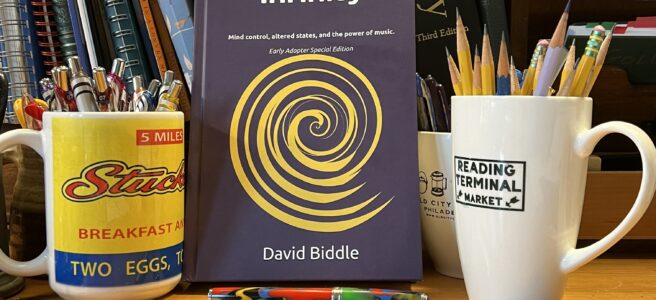
Finally, a hardcover, paperbound version of Sound Effect Infinity is available!
For now, you can only get it through Amazon. They’re set up to ship to you on-demand. Yes, you may have pre-ordered a version from my old publisher, but that book never shipped (sad face here). They were having issues with a big media company merger. After waiting three years, it seemed only right to take back my copyrights and go to work independently. That’s how real artists do things anyway. I’m not proud, just old-enough these days to be seriously tired and done with all of the bullshit.
[Note from 2026: A lot happened to prevent the proper publication of Sound Effect Infinity until February 2026, where this note is coming from. Click the links where you see them, and you’ll find the book posted to Amazon as a special edition hardcover offering. If you read below, you’ll see where things were, but not where they are now]
I already feel like a jerk. The only thing that is going to keep me from being selfish and single-minded here in 2024 is if I need surgery or get diagnosed with cancer or just don’t wake up some morning. A solid, working draft of my third novel for The Story Plant is due in December of 2024. The title we’re operating with right now is Notes on the Golden Country. I spent much of 2023 doing research and making notes for this year’s efforts. By late August I had started up on a first draft. As 2024 gets uncaged, I am about 120 pages in to Part I of three parts. I’m going to be a selfish jerk the rest of this year until I’m done. Meaning, I don’t want to come over to your house, go on a long walk, or anything else that will muddle my focus on writing this very odd story.
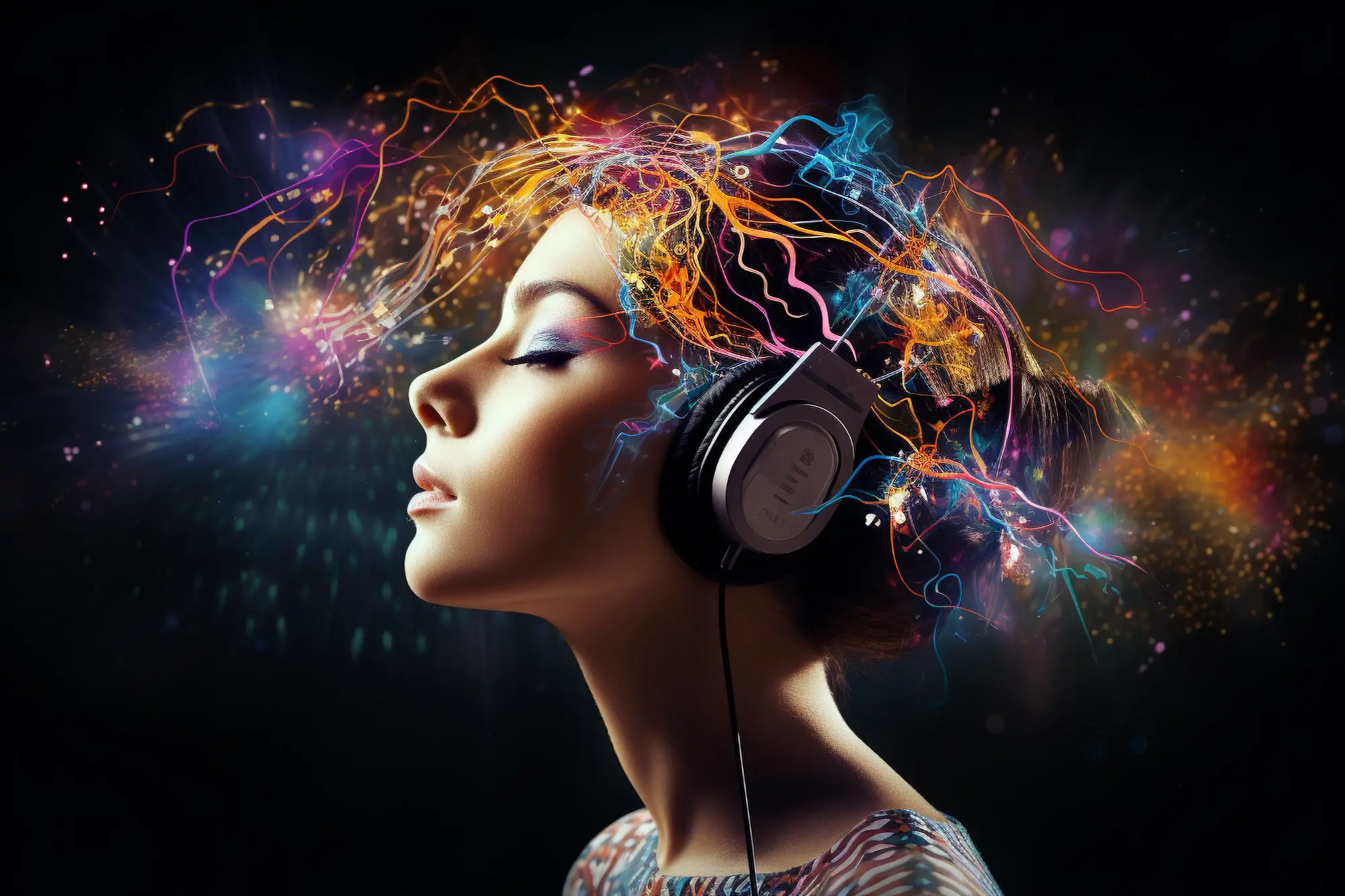
I’ve spent my entire life astounded by the magic of music, appreciating everything from opera and Gregorian chant to bluegrass and every kind of jazz there is. But what exactly is being touched in us and inspired when we listen to our favorite songs? What is this creation of new and complex emotion, the stimulation of sensuality, bittersweet memory, at times even, that awareness of sublime connection to the universe? How full and rich our lives are because of the beauty and profundity of sound waves organized into melody, rhythm, timber, and harmonic tones! Friedrich Nietzsche said it best: “Without music, life would be a mistake.”
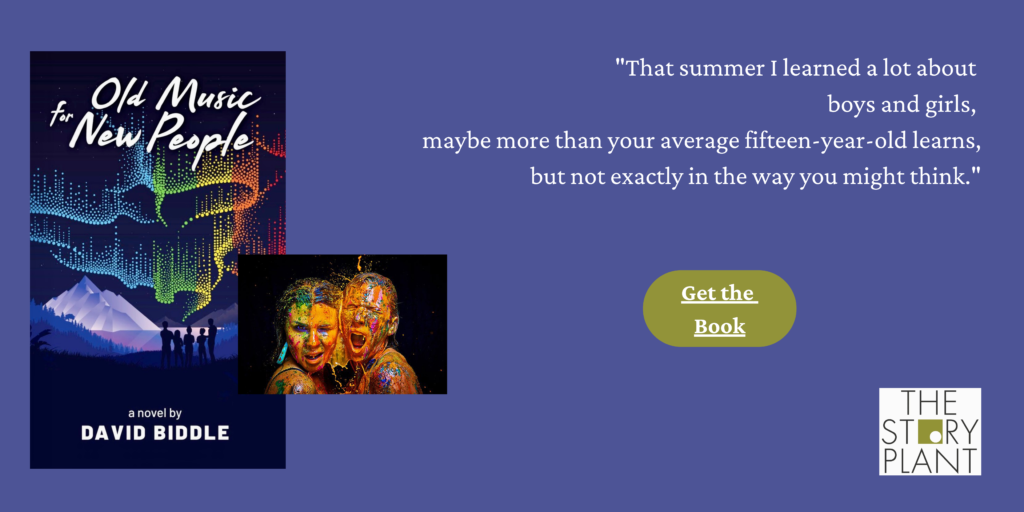
My novel, Old Music for New People, is driven in part by its characters’ thoughts and feelings about specific songs and musicians (baseball and food also have prominent roles in the plot). Many of the stories I write, whether long or short, have music painted into them. Sometimes I wonder if I’m a bit too hopeful about the idea of using words to describe what music does to characters emotionally and philosophically–and what it does to readers as well in their everyday lives.
We’ve all been wondering how to counteract the lunacy and mayhem that seems to have seriously marked 2015 throughout the world. Right? It’s not just terrorists, out-of-control cops, and criminals. There’s a lot of hatred a certain category of people have been spewing on TV, social media, and, probably, in your neighborhood and workplace.
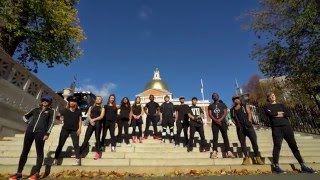
You may have your own answer, but to me the most powerful weapon global society has against all this fear and negativity is the freedom and joy of young people and the art they are making. Watch this video trailer below:
The full video can be accessed by clicking here: Community of Dancers Boston Edition. This is my youngest son Conor’s project. He is a 20-year-old film student (and hip-hop dancer) at Emerson College Continue reading →
I’m about to bombard all my Facebook peeps and Twitter followers with a breadcrumb path of links to Jeff Buckley videos. No apologies folks. Jeffy would have been 48 on Monday, November 17 (my mom’s birthday…she’s wherever Jeff may be now).
If you know Jeff’s work, then you’ll enjoy some of the choice clips I’m posting. If you don’t enjoy Jeff, watch them anyway, cuz this is a problem you need to resolve. The dude could sing, play, perform, and compose like no other (‘cept maybe Jimi).
And if you don’t really know Buckley, or if you’ve kind of just wondered, well, there’s eight short videos coming at you over the next 36 hours.
And let me note, this is not stupid fan-boy idolatry. I’m a musician and a singer. Music has been a huge part of my life. The dude was a fucking genius. The fact that we lost him at the age of 30 should haunt every one of us forever. He gets a super special cameo spot in my novel, Beyond the Will of God, because of the strange loss to music and the arts his passing meant. Pay attention to what he says in the interview I’m posting on Sunday evening. There’s some interesting stuff about the mystery of creativity and the power of music.
Happy Birthday, Jeff. Happy Birthday to Jeff’s mom, Mary Guibert, too. And a big Mmwaah birthday kiss to my mom, Ellen Horgan, as well.
The Jimi Hendrix Experience performs for Dutch television show Fenklup in 1967 (Photo credit: Wikipedia)
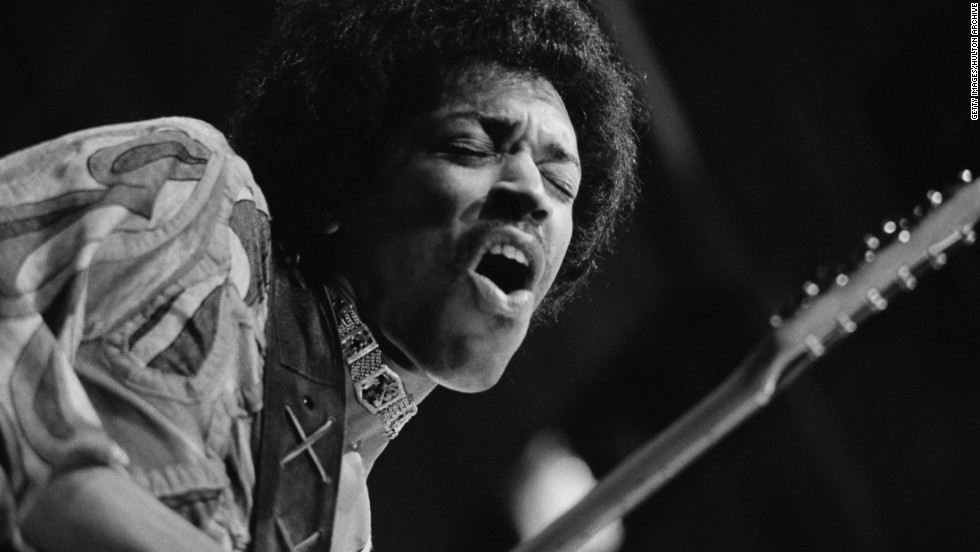
Anyone who’s watched video of Jimi Hendrix (or was lucky enough to see him in person) knows that his LIVE, improvisational guitar performances are unparalleled. His early reputation of wild child shaman boogie man was something many of us not only revered, but we saw that persona as an ultimate expression of who we thought we might want to be (us guys anyway).
As much as Jimi was the epitome of masculine style for us hippie-heads back in the day (gotta admit I was 9 – 12 when he was peaking) his stage presence with all its cosmic force and roaring witch doctor invention was what truly made you want to “Be Like Jimi.”
Here’s the interesting thing, though: musically, as brilliant and inspiring as his creative stage performances could be, it was his work in the studio crafting, creating, and massaging songs that was his true brilliance. The video below provides a good example of this genius and its effect.
Jimi wrote “The Wind Cries Mary” one night after arriving in England, and the next day The Experience recorded it on the fly during the last 20-minutes of studio time they’d paid for that day.
Watch the short video below for words from the cats who were there. It was just supposed to be a first-run demo kind of thing. Jimi kept figuring out new things he wanted to do with the guitar as they went along, so they kept dubbing these inventions in as fast as they could. I’m putting a link to the song at the end of this piece, too, so you can see the final product performed live just a few months later.
Note here what Eddie Kramer points out about Jimi playing the song’s chords softly while he sings the vocals. Jimi was very insecure about his voice. He needed to hug a guitar to his chest in order to sing the lyrics of one of the most beautiful songs that came out of the psychedelic era, something he’d written not 24-hours earlier. It’s such a treat for us 47 years later to have Kramer break down that moment.
The studio-Jimi, the composer-Jimi, and the techno-Jimi were the secret geniuses that we don’t think about enough. Go back and listen to those first albums (Are You Experienced?,Axis Bold as Love, and Electric Ladyland). His genius is still steaming in the air after nearly 50 years if you listen carefully enough.
What I want to know, though, is how he was able to be so gosh darned endlessly creative. I mean, we’re talking floating out above the heavens with his energy and musical soul all the time, every waking hour of every day. Yeah, it was the pinnacle moment in his life. Many gifted artists have their most prolific years from about 22 to 28 or so. Young synapses fire constantly. I remember so many of my friends when we were at that age (in the late ’70s and early ’80s), so many ideas, so much nascent art and political thinking percolating out of every orifice we had. But what we were doing obviously wasn’t as profound or freaking playfully connected to Infinity the way Jimi’s work was.
Maybe his creativity was partly more a function of all the people who were around him, along with being part of a moment in recording history when new tricks and gadgets were part of everyday music engineering for the first time ever. Obviously, there were more than a few insanely important artists roaming the world back then, bumping into each other, influencing one another and competing. And maybe, too, all the people around Jimi everyday, plus all the fans (and in those days we all knew good music when we heard it), inspired a palpable confidence in him, which in turn amped up the creative output, which in turn meant further acceptance and confidence, etc.
No one has come along since then with that level of fearless genius. No one. There’s a lot of talent out there, but no one comes close to that kind of creative force…in my opinion.
This is the second installment in a series on real people’s thoughts about Jimi and what he meant to them…and to modern music. Listen to the song:
For the past three decades I’ve been looking for novels and stories that illuminate the power of music. Rhythm linked with melody seems to go all the way to the depths of the human soul. This astonishes me. I have loved music all of my life. My father played every form of classical music in our house when I was growing up. And he played his music loud. By the time I was four it was profoundly comforting listening to everything from opera to string quartets or solo piano at volumes well in excess of five on a hi-fi system. During the heyday of the audiophile in the late ’60s and early ’70s, my dad built himself a monstrous stereo system using state-of-the-art electronics and Scandinavian components.I got to hear Mahler and Tchaikovsky so loud and so pure they went all the way into me and moved me forever.
Pop music touched me early on as well. I fell in love with The Beatles by the time I was six (summer of 1964) and its been clear sailing since. In 1971 my older cousin introduced me to Elton John, Crosby, Stills & Nash, Cat Stevens, and Joni Mitchell. A close friend in junior high school turned me on to The Jackson 5 and Stevie Wonder. My 8th grade girl friend got me to listen to The Allman Brothers Band. And when my younger brother received The Grateful Dead’s Europe ’72 for Christmas in 1973 we were hooked forever on improvisational music and the idea that guitars, drums, bass and keyboards could be blues, jazz, rock, country, and even classical all at once. By the time my ears and brain fully grew to be able to integrate and differentiate sound simultaneously, it seemed to me that music was as much a connector to spiritual ecstasy and joy as it was mere entertainment or just something that might give one a reason to do the twist.
Our emotions at any given moment are like surfaces in the dimension of awareness that precedes language. The way I see it, when music reaches inside of us, when the spirit of sound filters and flows through our ears and skin, the vibration and integration of beat and melody and song in the depths (and shallows) of the listener has the potential to deeply color and touch that dimension.
Sometimes it seems to me that music is what allows us to most fully feel our souls, to know that we are able to feel the entire universe all at once. By soul I don’t mean some mystical or spiritual force. I simply mean the essence of who we are summed into the moment — whatever emotions we’re feeling; whatever ideas we’ve had up to that moment during the day; whatever knowledge we have about others and how others feel about us.Music, of course, has a way of lighting up other emotions, often complex. You feel one way when you listen to Beethoven’s 9th and another driving down the road blasting The Rolling Stone’s “Street Fighting Man” at full volume. If you love music and if you are able to let yourself go, you can’t not feel something.
But here’s a question that I ask myself often: how much of what I feel is what you feel? More important, maybe, how much of what I feel comes from what I bring to the music and how much is the song itself coming to me? The easy answer would be that most of what you feel, maybe all of what you feel, is what you bring to the music. It almost fully has to be that way…solipsists that we are, ultimately, whether we like it or not.
And yet, there is still that common equation at work when we are at a party all dancing to the same beat. Or consider a concert and that feeling you have during a particularly powerful performance — that electricity or current of … of what? … connection? groove? synchronic linkage? commonality? communion? It doesn’t matter if it’s the Christmas opera “Amahl and the Night Visitors,” or Carlos Santana plus a 15-piece percussion ensemble.
I search for evidence of these issues in the arts. I read interviews by musicians and performers looking for references to these questions. The ecstasy and release at a Bruce Springsteen concert is legendary. The networked single mind created by a Grateful Dead concert (and now Furthur) was the magic that drew so many of us into that world. And the ancient communal connections created by everything from tribal to Gregorian chant — and then beyond — was a central motif to experiencing the divine — and still is, if you are so inclined.
I seek evidence of this magic in literature and poetry. It’s not easy to find. The tendency is to externalize this magic or to reduce it to some basic stimulus-response/cause & effect explanation. If you are reading this, I fear, in fact, that somehow my words may come off sounding idiotically mystical, supercilious, or mixed up and reminiscent of Don Quixote jousting with windmills. That is not my intent. My concern here is to get at what I think is the real magic of being human. This same issue of psychic connection and emotional power is at the core of love, sex, good food, and dance. It is at the root of all aesthetic experience — from viewing a sunset or a beautiful painting to reading a poem, watching a comedian or a movie, or even just taking a long hot shower.
We move through life knowing that we should pay attention and take the measure of that which brings us pleasure. But all too often what we actually do is move too fast. We don’t behold the world with much wonder.Think about this! So much of human experience is beneath the surface and before language and thought. Aesthetic emotion is real and possibly the most important aspect of being human. I think of it as what constitutes our souls. I think of it as the magic and mystery that gives life its power. I also know that the soul of who you are, that thing that can be touched and colored by loud or soft music (and so much more) is what truly connects us to each other. It seems to me that this soul I define is our life force and our essence. It seems, too, that so few people really get this, so few people understand how grand and fantastic this power is.Either that or this is my own little musical fiction and I’m half crazy, and these unanswered questions about the human soul are just the musings of a mind lying to itself far too confidently for its own good.
And maybe that’s why it is so hard to find novels and stories that go to the heart of this. Some come close, but they don’t go all the way. Maybe, too, that is why it is so hard for people to get along in this world and why the default psychology of so many is cynicism, nihilism, hatred, fear, and hostility. With that, I sign off. I’m going to go listen to Led Zeppelin’s “Stairway to Heaven”at full volume, then The Who doing “Baba O’Riley.”
I don’t need to fight, to prove I’m right./I don’t need to be forgiven.
This issue is explored much further through story, myth, character, and metaphor in my novel, Beyond the Will of God. You can check it out in Amazon. (Click Pete’s name, above, to see a video he did connected to all of this).
My new novel, Beyond the Will of God, is intended to remind readers of, or introduce them to, the playful, exotic, and mysterious elements of loud music that I believe we’ve forgotten. Beyond the Will of God seeks to thread the needle between serious mystery and quirky cosmic thriller. It is funky, humorous, and pathetically romantic — the way we used to be back in the day.
The book gets its title from a line in the Jimi Hendrix song, “1983…(A Merman I Should Turn to Be),”:
…And you know good and well
It would be beyond the will of God
And the grace of a king.
In many ways, this story is a murder mystery…but it’s wrapped in the magic of music…and then rolled up into cosmic questions that we used to ask ourselves all the time. What is the relationship between mind and body? What is telepathy? Why is the truth about altered states of consciousness so delicate and hard to understand? Where is the communal power of music coming from? And what about the psychedelic experience and music? Is that magic real? Or just mental dust?
A few weeks before he died, Jimi Hendrix gave an interview in which he talked about his aspirations for the music he wanted to write in the future. He said he wanted his music to change, that it should be about healing and peace, and that music was first and foremost a spiritual tool.
I’ve been struck by that statement ever since I heard it nearly 30 years ago. Back in the 1960s and 1970s the combination of blues, soul, funk, melody, and poetic lyrics were an enormous force of liberation in The Americas (and Great Britain). Whether you listened to Marvin Gaye’s “What’s Going On?,” an Allman Brothers instrumental like “Hot ‘Lanta,” “Riders on the Storm” by The Doors, or, say, Jimi’s “Power to Love,” you were moved, you were freed, and you knew you were part of something gargantuan. That gargantuan-ness was best exemplified by the loud guitar.
I don’t want to sound like an old-school prig, but most people don’t feel that way anymore about what they listen to. There’s no question that the music of today is just as good as the music of that bygone era (I love everyone from Global Illage and Citizen Cope to Honey Watts and The Roots). But music used to be at the center of what was once a powerful cultural shift on multiple levels all happening at once — we were waking up to how profoundly powerful the magic of the human mind is. Listening to Marvin Gaye or Pink Floyd or Santana took the heart and the mind of the listener on a trip that was both oddly spiritual and physically alluring. The link between emotion, language, and the body was something we were all really truly committed to understanding…and Experiencing. [Don’t get me wrong here: musicians are still working at this level; trust me, I know many amazing artists. It’s never been about anything but getting to the spinning heart of the magic of the human soul…I’m talking about the rest of us.]
Can you dramatize all of these issues? Can you make a story up that calls the reader to the back fence when everything almost seemed to make sense? Are there still mysteries here worth exploring? How does a writer delve into all of this and leave the mythologies of the past open-ended in a way that still lets the reader bring their own intuitions to the dance?
The only way to find out is to read Beyond the Will of God. Stay tuned and consider buying this e-book when it comes out on June 15. If you don’t have an e-reader, you can download Kindle for the Mac and Kindle for Windows. Just go here: Kindle Apps
Or use this as your excuse to buy a new iPad or Kindle. You know you want one.
Remember, June 15 is the release date at the Kindle Store. It will be interesting summer reading.
And for those who know what they’re doing, if you send me your Kindle email address (found in your Amazon account in the “Manage Your Kindle” then “Manage Your Devices” section), I will forward you an advance copy of Beyond the Will of God at no charge. This offer is good through June 14. All I ask is that you let people know about this book, and/or that you review it at Amazon after June 15th.