The Adoption Option: Teen Pregnancy in America

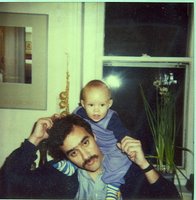
The author with his first son in 1988.

This blog, The Formality of Occurrence, began as a series of episodes that became the story of how I found my birthmother. I was adopted in 1958. My birth parents were both teenagers living in a small city in Indiana. My particular story was driven as well by the desire to understand my biological roots for my three sons beginning in 1988. I’d grown up with dark features and skin the color of creamed coffee. It was important to me to understand the story of my origin because the older I got the more I felt somehow cut off from all of society with no idea where I came from and what my beginning was in the story of my life. I didn’t want my sons to even remotely feel that way.

I found my birthmother (the story will be out as a book sometime within the next two years) and I now know that I am mixed race. My birthmother and I are very close. I am close as well to her husband and my three half-brothers. I’m proud to claim two quite separate lineages in the tree of life. And I’m proud as well to be adopted in this world. The adopted are special people. We spend our lives feeling separate and different, but we also spend our lives reaching out to everyone who will let us, embracing and loving, always knowing how precarious and risky life is. We know deep down inside how chance and luck play in to all human interaction. There are some of us who struggle with this weird situation we were born into. Some of us have anger. Some find it hard to trust others. I think it’s fairly likely that all of us carry with us a very powerful fear of rejection. I know for me, it wasn’t until I found the love of my life (we have been married now for nearly 22 years) and had children that I was finally able to lay down this quiet though determined sense of loneliness and disconnectedness in the world. That is a good thing. But I have experienced at times in the past two decades the sense that I might lose my connection to my wife and to my sons. I am advanced in age at 54, but my fear of loss is still profound and very powerful. 
But adoption is a good thing. I love my birthmother and my mother both. And I know that by adopting me my mother, Ellen Horgan Biddle, had her life changed forever. I know as well that adopting me allowed my birthmother to move forward with her young life and become the successful woman she became — and the loving mother of three other boys, my half-brothers. 
Daniel Taylor Source: Phila Inquirer
It is with this knowledge that I read a commentary piece today in The Philadelphia Inquirer on teen pregnancy. The article, called “Teen Pregnancy’s High Cost,”  points out that the U.S. teen pregnancy rate has dipped by 40% since 1990, but it goes on to point out that minorities have the highest rates by far and that 7,000 girls under 15 had babies in 2008. Written by pediatrician, Daniel Taylor, the article also points to the health problems of babies born to teenagers. It also points to the cyclical problem of teens having children who go on to become teenage parents themselves. 
We don’t talk about this issue enough. In this election year where politicians act like they care about poor people and the disadvantaged, there’s a lot of talk about welfare reform and modifying our health care system. But teen pregnancy has to be one of the single most obvious problems directly related to welfare, healthcare, education, and the health of “the family” in America. 
We all know that “right to life” proponents are hostile to the idea of giving women the right to make choices about their bodies. We know as well that “pro choice” advocates are concerned about women’s reproductive lives and often derisively at odds with right to lifers. The interesting thing is that those hostile to abortion are often strong advocates for adoption. But because in many states they have such a powerful connection to the adoption community, pro choicers have a hard time fully addressing that issue. The result all too often is that the question and issue of adoption is left out of the debate. 
It is also left out of the article I site above. How many of the 367,752 live teen births annually in America (3,500 in Philadelphia alone) end in adoption? We don’t know. The article doesn’t deal with this issue at all. Why? Because according to the Gladney Center for Adoption less than 2% of young girls who have babies put them up for adoption. I went to the website of the National Campaign to Prevent Teen and Unplanned Pregnancy. As far as I can tell that website provides nothing substantive on adoption at all. Adoption is called the third option. It is also called the silenced option. 
I don’t like the idea of abortion, personally. I also don’t like the idea that someone with a religious agenda and differing values can tell a woman (or a teenage girl) what to do with her body. But I also think that it’s very clear that if we know that teen pregnancy is a major problem for low income and minority communities in America, we need to do something big to change that. I would like to see pro-choice and pro-life advocates get together and figure out how to make adoption a definitive and viable option for everyone. Such a partnership should be organized and managed by the NAACP and probably the National Council of La Raza since the Latino community is more affected by teen pregnancy than most minorities (read Taylor’s article!).
Adoption is so important to this country’s future. We all know that many young married couples who struggle with fertility invest dramatic sums of money in the fertility industry. Why is that? Partly because people think that having their own “flesh and blood” is somehow important. But also partly because adoption seems so daunting and bureaucratic. The number of available children for adoption is far outstripped already by the number of families on waiting lists.   
This is a very sticky issue, I know. I am aware that I oversimplify here, but it’s also quite clear that teen pregnancy can’t simply be addressed by prevention campaigns and political rhetoric about the pros and cons of abortion rights. Adoption doesn’t just give babies a better chance in life, it also clearly gives young girls (and boys) the opportunity to mature and pursue educations and careers — and more normal family lives in the future. Adoption is very likely one of the most effective tools we have to stop the cycle of poverty.
The change I’m advocating here is not something that needs to happen off in a corner of urban America. We’ve been doing that for decades. Adoption needs to be culture-wide and upfront and in the center of things. I think every famous person who was adopted needs to make that public and a focal aspect of their identities. Maybe we should all wear turquoise ribbons on National Adoption Day (and maybe our adopting parents should wear bright blue). 
Athletes, actors, and politicians need to go out of their way to support American adoption centers. The next versions of Madonna and Brangelina looking for babies should make a point of staying within our borders. And the media needs to start covering adoption as an option for teenage mothers in a positive and empowering way. 
Don’t kid yourself. There’s still a stigma attached to adoption. It confuses people on all sides of the question. But I believe we’re getting smarter and less judgmental by the day. What we need is a world where 15-year-old girls who have had their futures jeopardized by pregnancy can consider a humane and realistic opportunity for the babies they are responsible for. I know we can make that happen. It’s too obvious and powerful a solution to just ignore or forget…or silence. 

Mobiusing the Self: Deep By Sound Alone

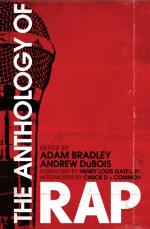
A review I did for TalkingWriting.com back in January of 2011 has been reposted as part of their summer “Writing and Music” feature. “Deep By Sound Alone,” (a magically crafted headline by Martha Nichols, founder and editor in chief at Talking Writing) is a review of The Anthology of Rap.

I recall being quite happy with the final state of this review. Typically, writing book reviews freaks me out. The more I publish the harder it gets to be critical of someone else’s work. I know firsthand what it takes to bring a book to press. I also know that the blood, sweat, and tears a writer and her team put into producing a book is not about looking to be criticized. 

But this review is about more than whether I liked The Anthology of Rap as an anthology. It’s about me learning to appreciate a form of music that I haven’t given a chance over the years. I’ve even said that rap isn’t music. In fact, I sort of say that in my review: 

I don’t agree with the premise that rap is poetry. Combined with its beat and sampled tape loops and all the other technological magic set to accentuate rhythm and meter, I’d say we’re listening to a new form that’s only beginning to understand itself.
The idea of new forms of expression, new perspectives on art, forms that go beyond our expectations, is so important to be aware of these days. New ideas about art and the human experience tend to portend big swells of societal change (look what rap did). We see our current economic malaise as this noose around our necks, but the truth is all the problems of commerce in this country (in the world!) are just symptoms of the need for change, or, as some are now saying, evolving. 
What we need to guard against now as this change begins to solidify is our innate irony and cynicism. Irony and cynicism can twist the logic of change and the excitement of possibility into self-referential flippancy. I was strongly reminded of that yesterday while reading an excellent New Yorker online essay by Maria Bustillos called “What Lester Bangs Taught Me.”

Lester Bangs is the legendary rock critic version of Hunter Thompson. He straddled the waning days of rock “as cultural expression” when it was morphing into New Age and punk. Bangs often wrote chunky, seemingly profound essays that began with questioning a rock star about, say, some fairly esoteric song but then went on for paragraphs linking every aspect of culture in his eyesight to the first question. Reading Bangs was like a mixture of words on the page by William Burroughs, Spalding Gray, Margaret Mead, and Johnnie Rotten all climbing on each others shoulders. 

Lester Bangs (Source: The New Yorker)
I was struck though, reading Bustillos’ wonderful reminiscence on experiencing Bangs’ words when she was growing up, that in the end he still put a big X across his mouth more often than not. He would spend whole essays profoundly wandering around the frontier cutting edge of social change and the meaning of life only to scribble it all into oblivion saying something like, “…but in the end, who the fuck am I to actually think I know what I’m talking about?”
Yeah. Well, who the fuck is anyone? We’re not stuck in some rut these days. Everything is changing as fast as hell. The only thing we’re not getting good at, yet, is figuring out how to create new meaning on the fly. It would be easy to just let it all shift and turn and not make decisions about what is right and what is wrong, what is true and what is utter bull shit. But that doesn’t work after a while. You get confused and vague like a lot of The Occupiers, or angry and insane like many of The Tea Partiers — or like the media is today with respect to the upcoming elections…and the politics of self-centered propagandists for greed in general.
I wrote a comment on The New Yorker website when I finished Bustillos’ Bangs piece. I want to share it here. If it doesn’t make any sense, that’s okay. It does to me. Read her piece! It’s all deep by sound alone. If you don’t get that yet, keep trying.
I grew through the Bangs Era absolutely clueless of him, but not what he addressed. That was our End Time…for a time. He was, it seems, it’s maw and soundtrack. Years later I bought Psychotic Reactions and Carburetor Dung. I was floored. I am grateful to Maria Bustillos for this rememberie. Besides the content of this essay, the writing itself is so perfectly twisted, I can see how someone with no bend or twist might get lost or frightened. In the end, I do think Bangs took the easy way out as a critic. He sort of Mobiused on himself. When you point at all the crazed revolution, and marvel at it (and its SOUNDS), but then make fun of yourself for drooling and say, in the end, it’s all bullshit and carburetor dung, well, yes, you are mimicking the Three Stooges quite well. There is meaning though, or anyway, or despite the Mobius cuteness Bangs arrived at. Yes, culture is all a joke and a plaything (especially rock music), but that doesn’t mean it isn’t also dripping with the darkness of our unconscious. I totally agree that “the first mistake is to assume Art is serious.” But the second mistake is to think that means you disregard its comedy as frivolous. Twist the Mobius brain a half more and you learn that the sublime and the ridiculous combine into the power of emotional intelligence and informed curiosity. Bangs led himself to the edge. I think David Foster Wallace figured out how to get out there over the edge, but it’s a stretch…the creative human mind is truly so much more powerful than we give it credit for and there is something you might call a New Way of Reasoning. It’s just still stuck on the tip of our tongues…or forks.
-Look for me on your local baseball field

Plagiarism and Other People’s Words: Welcome to the Revolution…or the Nuthouse

As an independent author, I am always tuned in to plagiarism and copyright issues. I’ve written on these topics already this year, but they are so vast and dynamic I want to first reiterate something important for all readers, writers, agents, publishers, and editors to think about. This industry is in the process of re-making itself from the ground up. There are no real rules anymore. There’s a revolution going on in the publishing world. And when things are hot during revolutions everyone’s confused as hell — especially those who think they know what’s going on.


The core principle of publishing has always been copyright law. The associated tacit principle “thou shalt not steal from another writer” has always been the first law of professional ethics. But these two issues are now getting a major overhaul whether we like it or not. And what’s really fascinating is that since no one really knows where we’re going and there are no longer rules in the industry we have lots of confusion and gray area to deal with. 

Take for example the most recent plagiarism scandal highlighted by the online mainstream press over the last week or so. Fareed Zakaria, a CNN program host and a columnist with Time magazine, admitted to copying several paragraphs written by New Yorker writer, Jill Lepore, for a piece he wrote on gun control. What’s most interesting about this story is not Zakaria’s quick and definitive admission of guilt, but a difference of opinion between Edward Jay Epstein in his “Fareed Zakaria Didn’t Plagiariaze!” piece posted by The Daily Beast, and Seth Mnookin, whose “No, Really, It’s Plagiarism,” was picked up by Salon.com. Read the comment section after each of these articles to see how bizarre this one is. It’s actually quite hilarious.

Let’s go one step further. Earlier this summer we saw an interesting twist in the plagiarism game – Jonah Lehrer, a rising star who moved from Wired to The New Yorker, was accused of “self-plagiarism.” In essence, he was accused of cutting and pasting pieces of blog entries into blogs he wrote for The New Yorker. The problem was attribution, I suppose, but it really seemed to me that Lehrer was being treated like a 14-year-old accused of statutory rape because he figured out how to masturbate and act like nothing is wrong with it. Not exactly plagiarism, but it was too weird for everyone to deal with, so he got in trouble.

From my perspective, these recent word theft scandals are just part of frontier life for all of us in publishing. Confusion about self-plagiarism and Zakaria copying someone else’s words, comical as both situations are, shows that we’re (and I truly mean all of us) living out a sort of “King of Hearts” revolution. The Internet is like a vast lunatic asylum masquerading as a pro sports team locker room. If you don’t believe me, check out Michael Barthel’s long Salon.com piece on the Zakaria scandal

I am not an expert on these issues. I’m not sure you can be an expert on anything in the publishing world anymore. But it’s important to look at plagiarism and copyright issues as an area where we are all forced to reconsider what we thought we knew about books and writers and reading. If you ask me, this re-thinking doesn’t start with journalists and mainstream writers, it starts with a much larger, more diffuse, and truly influential group — indie writers.

Us small fry in the publishing world are at the mercy of venal, money-grubbing con-artists and thieves. My first independently published novel has been available through Amazon’s Kindle Store for just a bit more than two months and already weird stuff is happening with the paperback version. You probably know that Amazon’s sales pages always offer new Amazon copies but also have links for independently sold books and used books. In the past two weeks, the paperback edition of Beyond the Will of God is being offered off Amazon’s site for anywhere from about $14.00 to nearly $35.00. That’s all very interesting since the paperbound version is priced at $15.99 brand new through Amazon and CreateSpace. You can’t make money below that price, and who would buy something for double the cost when its readily available through Amazon at such a reasonable price?

It’s very likely that hundreds of indie writers recycle blog material and copy and paste from each other all the time. The only reason they aren’t “caught” is that they aren’t in the mainstream (and money isn’t involved). There’s no question in my mind as well that indie stories and books are being mined for ideas and plots. I am about to take advantage of the Kindle Direct Publishing (KDP) program and offer as a promotion this weekend three days of free downloads of my novel. I’m going to guess I get several thousand takers. Thousands of other KDP writers will do the same thing this weekend. Who is doing the downloading? I have no idea. When “Free” is involved, random takes over. And in this world, “Free” is a global proposition. There could be syndicates in Eastern Europe or Africa or Asia downloading, breaking the digital rights management code, and then repackaging my story for sale at any price they want. What can I do? 

Paranoid ramblings? Hardly. Already people are selling my book irrationally and I don’t see a dime from their success. Writers have had to deal with this issue forever, just not at such dramatic volume. Do I care? Not really, although its still all very interesting. I know that hundreds, if not thousands, of good-hearted, gentle readers will also be downloading my book. I hope they read it. I hope, too, that they like my writing enough to want to buy my collection of short stories. I’m banking on building up a group of folks who want to buy the other two novels I will be putting out over the next year and my second collection of short stories. If there are assholes looking to profit off of illegal copies of my work or folks who want to steal ideas and even paragraphs from my blog entries, so be it. 

There’s one rule in this whole publishing frontier that is essential: writers write. Some people won’t follow this rule very well for whatever reason (I can only imagine the pressures Zakaria and Lerner were under that would cause them to cut corners like they did). For most of us, especially us indie folks, the whole game may be lawless and out of control (and insane), but working hard to come up with great stories, relatable characters, and new ways of talking about the world is still the whole idea. What distinguishes a writer is not whether he or she has a contract with a Big Six Publishing House but production. For indie writers, production is wholly self-motivated. No one tells us what to write and no one gives us deadlines. We can post love stories between giraffes and zookeepers just as easily as we can kinky romances between billionaires and breathless twenty-something Lolitas. 

The system is in place now to get whatever we’re writing out there directly to readers. We don’t have to posture or guess what our market segments will be (although we do need to make sure people know our books are available). And we shouldn’t be too worried about this revolution that’s going on and whether folks are trying to figure out how to make money off our hard work without us benefiting. 

The lessons the pros are learning right now (and their publishers) will help all of us get a better handle on professionalism and ethics and what it means to be out here on the frontier leading-edge of things. Hopefully the big guys will re-employ fact checkers and develop explicit standards of conduct that make sense. That may take a while, though, since the publishing world is all of a sudden chaotic and super competitive. 

In the end, I believe that quality, original writing and creative, thoughtful insights through that writing will carry the day. I’m sure Jonah Lehrer and Fareed Zakaria know this now. You as a reader have always known this. Keep watching as “content providers” try to police themselves and figure out who they’re becoming. We really are like a bunch of lunatics let loose in a locker room. The weird thing is that we get to go out on the field whenever we want, and whoever is out there gets to watch us do whatever we think we’re supposed to do. It’s going to require some time, but eventually the rules will become obvious again and things will settle down. I hope it takes a while for that, though. I kind of like being free to make things up as I go along.

I hope Lehrer, Zakaria and all the other nuts who are getting sent to the showers can get back on track with this freedom thing. As Patti Smith once sang: “This is the era where everybody creates.” Welcome to the era, then. It’s a nuthouse.

___________________________________


If you want to read more on what plagiarism implies, see my April article, “The Word Thieves,” at TalkingWriting.com HERE.

America’s Finest Are Coming: Teaching in The Age of Inspiration

A teacher in the making.

When I was in college trying to figure out what I would do with my life, I knew that my “fall back” job could be as a teacher. It really didn’t matter what level of teaching — to me being a professor at a prestigious university was the same as teaching social studies to 7th graders or running a 1st grade class at a suburban or urban school. Teaching was an honorable profession with decent pay and usually quality benefits. But to me it was also removed from reality. I grew up in an academic household. To me, teachers talked about the world and educated about it, but they didn’t actively participate.

In the end, I became an environmental planner and activist. I put my social science education and math abilities to use as a consultant specializing in energy conservation, technology efficiency, and recycling. I had a marvelous and exciting 30-year career working with the public and private sector trying to make our energy and solid waste infrastructures more effective and safe. I’m a novelist and freelance writer now (something not so different than being a teacher). But that’s not what I’m writing about here.

I just looked at my FaceBook wall this morning and found an invitation to donate funding to help a 2nd grade teacher buy Kangaroo Pouch organizers for his students. This teacher is part of a new movement in education. He is 24 years old, with a newly minted masters in education from the University of Pennsylvania. He has been an adjunct teacher on and off for the past two years working with elementary schoolers in Portland, Oregon and Philadelphia. This 2nd grade class is his first full-scale appointment as a bonafide, credentialed educator. He is committed as hell to his job. Besides his education at Penn, he spent this summer training with Teach for America to prepare him for this coming school year. This teacher is my oldest son, Sam.

Now, I am just a poorly paid author, but I donated $20 to Sam’s Kangaroo Pouch project. Sam’s school is the Frederick Douglass Elementary School in North Philadelphia. It is a public school, but it was designated as one of many schools in Philly that needed extra special support. Sam doesn’t work directly for the Philadelphia School District. He is an employee of Young Scholars, a charter school non-profit contracted to help turn around Frederick Douglass Elementary. Young Scholars is one of many innovative private and nonprofit organizations working on new models for education and community development throughout the country. There are not enough organizations like Young Scholars…yet. But I think that’s about to change.

Other charter oriented education programs like KIPP and Mastery Charter are doing amazing work with inner city kids throughout the country. I don’t want to debate the value of charters over public school systems, though. I think that’s a ridiculous argument. The object is to adequately fund teachers and administrators to provide committed, informed, and effective education to kids everywhere in this country. There is no one system that will work. We are a nation of sub-cultures and neighborhoods that all blend in one way or another in schools more than in any other local institution. Whatever works! Right?

I don’t want to debate the economics of education here either. Although it is clear that if we don’t figure out how to adequately invest in our children, this nation is going to slide backwards on the world stage. We’re going to see more crime, drug abuse, teenage pregnancy, illiteracy, and unprepared adults in the work world.

What I do want to point out is that the message young teachers are now getting (usually from experienced and profoundly gifted older teachers) is both exciting and dynamic. The future of this country, I believe, is positive because of this message. There is enormous excitement in the world of teaching right now. Talk isn’t just about minimal standards, literacy, and basic skills, its about leadership, community development, and passionate commitment. Young teaching recruits are not taking “No” as an answer. I think this is possibly true of many teachers that we all had in the past, but today’s world of astounding media technology, social networking, and communication systems provides teachers with a virtually infinite toolbox of solutions to problems (Sam’s DonorChoose solution for Kangaroo Organizers is just an example).

From child preacher to teacher, Bernie Wilson.

I’m finding evidence of the extreme dynamism of this profession everywhere I look these days. Experienced teachers, men and women of my own generation — Boomers who have never truly chucked their aspirations for a better, more socially just world — are passing on their wisdom and the lessons they’ve learned to this next generation. Take a look at the video attached to this web page on a talk by my friend Bernie Wilson that just came my way through FaceBook last week.

The Age of Inspiration

Sometimes when I’m waiting for my computer to re-boot or while I’m making lunch, I wonder what we may one day call this next few decades here in America. We are at a major juncture in our history. The hippie generation is in the heyday of its leadership. Our collective knowledge about how easy it is to fail and to miss the mark is turning into wisdom. Bernie’s words give me goosebumps.

I think I know what we should want to call this next couple decades. These next 20 years or so need to be called The Age of Inspiration. We have so many drastic problems: global warming, health care, proper investment in our communities, and development of a more sustainable economy. If we don’t approach these problems as inspired, can-do citizens, we may stay mired in the past. And, quite frankly, the past didn’t work.

But we Boomers can’t be the only ones saddled with doing the inspiring. The real job is for this next generation of kids. I am amazed by the young people I know who are choosing education as a path. I end this essay with a very brief video of this year’s Teach for America recruits at the closing ceremony for their summer training in Philadelphia. As you read this, they have fanned out to eastern cities far and wide to begin the next phases of their lives. Some of them will stick with teaching. Some will move on to other professions. No matter what, you can bet they will be touched by their time teaching the generation coming up behind them. We are a great nation because of the inspiration of our young people. That inspiration comes from their teachers first and foremost. And so it goes.

The speaker in this video is one of the great heroes of my life. I couldn’t have become the man I did if he hadn’t been born. To be touched by a teacher in the making for the past 24 years has been quite a treat. But what’s more important about this video, is to listen to his peers as he speaks. This is what I’m talking about. This is who we can become. This is the world we can live in. They can be the ones who raise us all towards The Age of Inspiration. Teaching as a fall-back career? I couldn’t have been more mistaken.


Enhanced by Zemanta

Therapy for the Writer: Learning to Trust the Subuncular Mind

It’s all so simple!

Years ago I learned how weird the creative mind is. Subconscious thought needs to be given a great deal of leeway in the artistic process. One of the first real short stories I wrote (real meaning that it wasn’t written as an assignment for a creative writing of English class) was called “The Rapist.”

I’d been reading a lot of Russian literature, particularly Dostoevsky, Chekhov and Gogol along with European existentialism and theater of the absurd. I was 21 at the time and had taken a semester off from college because my major — anthropology — meant I wasn’t getting enough opportunity to read what I wanted (which was fiction — existential fiction in particular). I also wanted to see what would happen if I just got up every morning and wrote with no purpose and no planning.

At first I wrote pathetically pedantic plays with characters espousing idiotic philosophical notions about mortality, God, and religion.  What I really wanted to do, though, was try my hand at short stories — completely improvisational, off-the-wall fiction that was improbable, unpredictable, and ridiculous. I also wanted to fully escape the notion of symbolism, theme, or intention. 

So, eventually, I wrote this 24-page, single-spaced story called “The Rapist.” As I recall, I first typed the title at the top of the page, then I started with a sentence and just kept going. The story evolved into a kind of near-future thing filled with turn of the century Russian identity references. This guy in his late twenties befriends a young girl one night walking empty streets. He takes her back to his cube. Everyone lived in cubes. And they sleep together. The girl is a young teenager, maybe 14 or so. She is innocent and childlike and needs to be protected and taken care of. He means well in the beginning, but his desire gets the best of him. 
After the first draft, I felt like there was a lot missing from the story. Indeed, this was a world in which only two people existed. Who were they? Where did they come from? What did they do? How, especially, did this guy earn a living? 
It came to me in the middle of the night after a discussion with my girl friend about Freud and Sartre. The guy would be a psychiatrist and he would have these sort of Socratic dialogs with the young girl before and, then, after he had made love to her, and the dialogs would be different after sex. All along as I pondered through this weird little story, I also truly did not like the title. The Rapist? It was there to draw a reader in. It was there, too, I figured, because the idea of statutory rape always seemed to me strange. I lost my virginity when I was 14. My girl friend at the time was 15. I figured the title was plenty provocative enough all the way around. And I hoped that at least my housemates would get a kick out of such provocation. But still…the rapist? 
When the story was more or less the way I wanted it to be (except the title), I gave it to friends and they didn’t really say much. But I also gave it to my mother to read. My mother in those days was the age I am now — so full of piss and vinegar, an in-your-face feminist sociologist with lots to say about how men were the reason human history was so violent and chaotic. She read the story and loved it (what would any writer do without a mom?). I told her I thought the story needed a new title. She said, “Are you kidding? This is the best title you could possibly give this story. It’s perfect!”She was effusive and adamant to boot. I was a bit taken aback. “Really? You don’t think it’s a bit much?” She took off her glasses and rubbed here eyes. “You don’t see it, do you?” I shook my head. “The Rapist?” I shook my head again. “Put the two words together,” she said and then waited.
A little electric jolt shot through me. The Rapist = Therapist? “What?”
My mom was a Mary Daley reading feminist who had spent two decades in the care of psychiatrists. Why would she not see this? It was Feminism 101. But what about me? I honestly had no clue about gender puns. The story I’d written came out of nowhere. It seemed so off the wall and abnormal. It seemed at times like it was coming from somewhere else. The easier it was to write, the more bizarre it got.
I’d determined that I would write something with no intention and with no plan or meaning, and I’d come up with a very specific and culturally defining story about a therapist who seduces a girl and then tries to deal with the question of shame…and whether he should feel love for her. “The Rapist” indeed. 
Out of that strange interlude 33 years ago I learned to always let my sub-conscious mind have a major say in my work. There’s a balance, of course, and the truth is that “The Rapist” is written in a pedestrian style that makes me cringe whenever I look at it (it also has an extremely timid sex scene built into it). 
This balance between the conscious and unconscious is always taking place in my fiction. Writing stories is an endless exercise in self-discovery. I have two novels that will be published over the next year that wrestle with the interfaces between sex and love and whether life has any truly profound intrinsic meaning (yup, still at play with Russian and existential issues…sorry…any writer who isn’t is a fool and a waste of time for you, the reader). 
Both of these novels are fueled by the insanity of growing up and becoming an adult/parent/male/husband from 1980 through 2010. That was a really fucked up thirty years in a lot of ways for all of us. What the hell did we think we were doing? Ouch. It still hurts just to think about it. But there was so much more going on under the surface for all of us. These two novels (and a really weird aborted one full of truly twisted male sexual fantasy) developed from 2000 to 2010 as I personally grew to understand who I was and was not and how terribly stupid I was about love and sex and the question of the meaning of life. 
In short, these two novels — Beautiful Morning Blues and Ex:Urbia — came about as advanced and refined balancing acts between the conscious and the unconscious. Beautiful Morning Blues was so overwhelming that I wound up in the hospital and nearly died. And writing the first draft of Ex:Urbia so turned my sense of inadequacy and desperation about true love inside out, glowing on my skin, that I nearly lost the love of my life. 
Make no mistake about it, writing can get kind of dangerous. Letting the subconscious play some with words and meaning in the conscious world is just plain spooky. The closer one comes to producing metaphors and mythologies that get at the truth of being human in the 21st century, the closer one comes to the legitimacy of insanities, addictions, and nightmares. And yet, if we don’t come close to these things, how is it that we learn to rise above them and fully embrace the majesty and grace of real love and real meaning? 
This is my take anyway on what literature is about. As I learn to market my first novel, Beyond the Will of God, which is, at least in someways, about the reality of fantasy and the power of music and the creative mind, I am struck by how little people want to think about the nexus between their conscious and unconscious minds. What happened to people’s awareness about how essential it is to face the beast within that governs so much, that is before words? 
To me that beast is both sobering and amazing. The word I use for it is Subuncular. That’s a cross between sub/unconscious and avuncular. It’s there, we need to trust it, but it’s so deep and so hard to see. And yet…
I leave you with this new little oddity I’ve beein dealing with of late: 
I began my fourth novel, working title: Dawn of the Summertons, in January, the day after I hung up my spurs so dusty and worn out from a 30 year career as an environmental consultant. It’s a story about a family. I started out as I now know to do: deciding on point of view and narrative voice. As all writers understand, “head hopping” through multiple points of view is not good for the reader. You need to know what your voice is going to be. At first I wanted the story to be told by little Bess, the youngest of three siblings. But children’s voices are to my mind a cheap way to embrace the reader. Besides, I want this story to tell what it’s like to be an adult in this world — a parent, spouse, lover, and sharpened soul in this modern world of media and myth. 
After a bit of trial and error, I fastened on using a straight third person voice. But I was also sloppy enough (I like sloppy) to slide in omniscient observations of each family member’s thoughts. I got through the first third of the story (just under 60,00 words) in just three months. And then I hit a block. 
It wasn’t like I had writer’s block, exactly, not in the classic sense, anyway. What happened was that every time I got to work on this one scene I would become profoundly sleepy. It didn’t matter how much coffee I had. It didn’t matter how much sleep I got the night before. I would just become overwhelmingly tired. In the past three weeks it got so bad that I would literally fall asleep while I typed every day. I’ve written about 5,000 very sleepy words in the past four months. 
What the hell was wrong with me? Not only was I falling asleep trying to work on my novel, but all my other fiction began to seem confusing and meaningless. Today was no different. I tried working on the same scene and just oozed into dreamland. I stopped that, went downstairs, made a monstrous cup of coffee. Drank it down. Listened to loud Led Zeppelin and went to work editing stories that I’m going to be publishing soon in a collection called Implosions of America. But the words I was looking at made no sense. I decided to lie down. 
I am not sure why today I figured things out. But my head hit the pillow and within a minute I realized — truly, out of no where — that I needed to go back upstairs to my office and write something from the older brother’s point of view when he is a 50+ year old man looking back on his life. I fought this idea for a good 15 minutes, lying there in the heat of an early August morning with a fan blowing over my exposed legs. “What’s the point? I am not writing in the first person here. That’s not the plan!” 
And yet…by a little past noon I was back at my desk and I was writing in Lester’s voice fifty years in the future. His words came out of me like full spectrum waters lit in browns and grays and then glowing slightly with a rainbow shine, then silver and gold, and back to brown and gray. I wrote for two hours straight, Lester’s wizened voice just pouring out of me, explaining his view of why men are so desperate in their love and why life is so, so hard for all of us. 
I stopped when I realized that I needed his sisters’ voices to chime in too, and his mothers. I’m still not sure whether Reggie, the father, should have a shot at talking to the reader, but I know once again that the subuncular needs to have some room to express itself. I’m giving it all the rest of the day and know when I wake up tomorrow morning more will come and I won’t feel tired and everything will make sense again. 
That’s probably the hardest thing about being a writer. You can talk to as many people as you want about writing and publishing. Whatever. You can pay for a shrink. You can push and push and push. But sometimes the only therapy you need is balancing on that nexus between what you think you want to do and what you need to do. 
When you first start out its usually pretty easy. You don’t know what you’re doing. Your subuncular self is able to take over because the ego is an idiot. As you grow and develop, though, as you gain a bit of control and mastery over language, it’s easy to forget that interface between two minds. It’s also natural that one wouldn’t want to perch on that balancing point where the conscious and the unconscious meet. Like I say, it’s spooky. Staying close to what is spooky is pretty uncomfortable. 
And yet that’s where stories worth telling live. At least that’s the way it seems to me. 
So, back to the beginning of Dawn of the Summertons. I’m just glad we will be saving money on coffee now. Although, I will kind of miss my late morning naps.
Teenage Wasteland: unanswered questions about the significance of music

For the past three decades I’ve been looking for novels and stories that illuminate the power of music. Rhythm linked with melody seems to go all the way to the depths of the human soul. This astonishes me. I have loved music all of my life. My father played every form of classical music in our house when I was growing up. And he played his music loud. By the time I was four it was profoundly comforting listening to everything from opera to string quartets or solo piano at volumes
well in excess of five on a hi-fi system. During the heyday of the audiophile in the late ’60s and early ’70s, my dad built himself a monstrous stereo system using state-of-the-art electronics and Scandinavian components.I got to hear Mahler and Tchaikovsky so loud and so pure they went all the way into me and moved me forever.

Pop music touched me early on as well. I fell in love with The Beatles by the time I was six (summer of 1964) and its been clear sailing since. In 1971 my older cousin introduced me to Elton John, Crosby, Stills & Nash, Cat Stevens, and Joni Mitchell. A close friend in junior high school turned me on to The Jackson 5 and Stevie Wonder. My 8th grade girl friend got me to listen to The Allman Brothers Band. And when my younger brother received The Grateful Dead’s Europe ’72 for Christmas in 1973 we were hooked forever on improvisational music and the idea that guitars, drums, bass and keyboards could be blues, jazz, rock, country, and even classical all at once. By the time my ears and brain fully grew to be able to integrate and differentiate sound simultaneously, it seemed to me that music was as much a connector to spiritual ecstasy and joy as it was mere entertainment or just something that might give one a reason to do the twist.

Our emotions at any given moment are like surfaces in the dimension of awareness that precedes language. The way I see it, when music reaches inside of us, when the spirit of sound filters and flows through our ears and skin, the vibration and integration of beat and melody and song in the depths (and shallows) of the listener has the potential to deeply color and touch that dimension.

Sometimes it seems to me that music is what allows us to most fully feel our souls, to know that we are able to feel the entire universe all at once. By soul I don’t mean some mystical or spiritual force. I simply mean the essence of who we are summed into the moment — whatever emotions we’re feeling; whatever ideas we’ve had up to that moment during the day; whatever knowledge we have about others and how others feel about us.Music, of course, has a way of lighting up other emotions, often complex. You feel one way when you listen to Beethoven’s 9th and another driving down the road blasting The Rolling Stone’s “Street Fighting Man” at full volume. If you love music and if you are able to let yourself go, you can’t not feel something.

But here’s a question that I ask myself often: how much of what I feel is what you feel? More important, maybe, how much of what I feel comes from what I bring to the music and how much is the song itself coming to me? The easy answer would be that most of what you feel, maybe all of what you feel, is what you bring to the music. It almost fully has to be that way…solipsists that we are, ultimately, whether we like it or not.

And yet, there is still that common equation at work when we are at a party all dancing to the same beat. Or consider a concert and that feeling you have during a particularly powerful performance — that electricity or current of … of what? … connection? groove? synchronic linkage? commonality? communion? It doesn’t matter if it’s the Christmas opera “Amahl and the Night Visitors,” or Carlos Santana plus a 15-piece percussion ensemble.

I search for evidence of these issues in the arts. I read interviews by musicians and performers looking for references to these questions. The ecstasy and release at a Bruce Springsteen concert is legendary. The networked single mind created by a Grateful Dead concert (and now Furthur) was the magic that drew so many of us into that world. And the ancient communal connections created by everything from tribal to Gregorian chant — and then beyond — was a central motif to experiencing the divine — and still is, if you are so inclined.

I seek evidence of this magic in literature and poetry. It’s not easy to find. The tendency is to externalize this magic or to reduce it to some basic stimulus-response/cause & effect explanation. If you are reading this, I fear, in fact, that somehow my words may come off sounding idiotically mystical, supercilious, or mixed up and reminiscent of Don Quixote jousting with windmills. That is not my intent. My concern here is to get at what I think is the real magic of being human. This same issue of psychic connection and emotional power is at the core of love, sex, good food, and dance. It is at the root of all aesthetic experience — from viewing a sunset or a beautiful painting to reading a poem, watching a comedian or a movie, or even just taking a long hot shower.


We move through life knowing that we should pay attention and take the measure of that which brings us pleasure. But all too often what we actually do is move too fast. We don’t behold the world with much wonder.Think about this! So much of human experience is beneath the surface and before language and thought. Aesthetic emotion is real and possibly the most important aspect of being human. I think of it as what constitutes our souls. I think of it as the magic and mystery that gives life its power. I also know that the soul of who you are, that thing that can be touched and colored by loud or soft music (and so much more) is what truly connects us to each other. It seems to me that this soul I define is our life force and our essence. It seems, too, that so few people really get this, so few people understand how grand and fantastic this power is.Either that or this is my own little musical fiction and I’m half crazy, and these unanswered questions about the human soul are just the musings of a mind lying to itself far too confidently for its own good.

And maybe that’s why it is so hard to find novels and stories that go to the heart of this. Some come close, but they don’t go all the way. Maybe, too, that is why it is so hard for people to get along in this world and why the default psychology of so many is cynicism, nihilism, hatred, fear, and hostility. With that, I sign off. I’m going to go listen to Led Zeppelin’s “Stairway to Heaven”at full volume, then The Who doing “Baba O’Riley.”

 
I don’t need to fight, to prove I’m right./I don’t need to be forgiven.

It’s only teenage wasteland.

___________________________________________

This issue is explored much further through story, myth, character, and metaphor in my novel, Beyond the Will of God. You can check it out in Amazon. (Click Pete’s name, above, to see a video he did connected to all of this).


Great Blogs to Read: Truth and Beauty – Young Adult Old Soul

I want to point you to a couple of independent writer/artists I’ve been in touch with while on vacation in Florida. See photos that have nothing to do with either author. 

I read a great post by Laxmi Hariharan in early July titled “Dare to Be an Indie?”. That post inspired me to think about the end product of writing, particularly the product created by indie authors. So I explored Laxmi’s offerings a bit and saw that she is a quality, thinking, vibrant author living in Londan. I just had to reach out and tell her how great I thought she was. I also let her know why her piece inspired me. She responded back with a guest blog request so if you’re interested, you can see the result of her request at her website right now. Check out “Letting Go: Indie Marketing Made Easy” at Laxmi’s site, Young Adult Old Soul. I mean every word I wrote there. 
Today, I also happened to stumble onto Dan Benbow’s website, Truth and Beauty. I’ve reported on this site in the past. Dan has been my editor at Kotori Magazine on and off over the years. I’m hoping I can get Kotori to consider publishing a sample chapter from Beyond the Will of God for their readers.

Sometimes I worry about calling my novel what it is — A Psychedelic Mystery. But I know Kotori Readers will appreciate that concept. Most other people just get tongue-tied and sadly PC about the idea. There should be more psychedelic frolics in the art world. The plasticity of consciousness and creativity is rather important to consider…

But I digress. Last Friday, Dan posted a nice piece on Charles Bukowski at Truth and Beauty. It’s a great essay, and I put in my two cents worth at the end in the comments section. Dan offers a couple good poems to read by Chuck B and also by one Thomas Waits, along with his own intelligent thoughts. I did not know about the documentary Dan notes in his piece. It looks damn good and you can watch it on YouTube, so go to Truth and Beauty to read and to link. 
I will be back from our family outing to South Florida on Wednesday. Saw great minor league baseball  (though Jesse Biddle struggled some on the mound…just one of those games…we still got watch young batters try to hit his 93 mph fastball and fail a lot); have been taking long beach walks under an electric sun; lots of time sitting quietly in an out of the way part of our hotel working on my next short story “The Scent Leaver;” and have been part of the unofficial Loggerhead Turtle siting committee, though last night I fell asleep while the crew was out under bright moonlight. We’ve had a fair number of turtle confrontations. The best was a 7:30 AM encounter with baby loggerheads on their maiden run from hot sandy nests into the sea. About 40 of ’em in a 15 minute span making their fin flapping “run” into the infinite green. Awesome!
My love to all. My novel wants you to buy it! And then read it…follow the path with a heart.
Make sure to bookmark Dan’s and Laxmi’s blogs, too. They both offer independent insights you probably won’t find anywhere else and interesting, quality writing to boot.

-db

The Powers of Mind: An Introduction to the Mystery of the Cosmic Egg

My introduction to how mysterious and seemingly magical the human mind is came from a reading of POWERS OF MIND, at one time a national bestseller written by Adam Smith (a pseudonym for George Goodman, a high-end journalist and editor). I read this book in the mid-1970s.

Powers of Mind was basically a long set of straightforward descriptions of everything from biofeedback and memory quirks to meditation, rolfing, and psychedelics. I was 17 at the time. From there I devoured books by Carlos Castenada, Aldous Huxley, John Lilly, and Ram Daas. My favorite — then and now — was THE CRACK IN THE COSMIC EGG, by Joseph Chilton Pearce.

Needless to say, like so many people back then, I did my own experiments with consciousness, going as far as I felt comfortable on the outskirts of Mind and Reality. This experimentation lasted about six years. By the time I was 22 I just didn’t have the emotional strength and intellectual stomach to run around on the frontier of psychology anymore.

That said, I’ve never stopped thinking about and questioning the mysteries of the cosmic egg and the human spirit. Through most of those days of exploration and then for several decades after, I took the route that a lot of folks do with this stuff. I wanted to know what the underlying mechanisms were. I wanted to know the chemistry of altered states and the physics of energy flows and the cosmological explanations for things like precognition, remote viewing, and ESP. I tried reading books like Jung’s SYNCHRONICITY and the McKenna brothers’ INVISIBLE LANDSCAPES and followed neuroscience and psychology closely (at least as close as a layperson can).

But around the time my first son was born, and then extending out through raising him along with his two younger brothers, I came to the conclusion that understanding the science and math behind the power of the mind is a fool’s game. For some folks, perhaps, it is necessary to get at what is really going on during, for instance, an explosive DMT encounter, or with someone who can communicate with the dead. But for me, the real power of the mind comes from the mysteries that it can behold…just simply behold.

Some people seek profound transformative connections with the cosmos (or God…or whatever). Some understand so much more than I ever will because they practice meditation regularly. Some folks seek that all elusive thing called Enlightenment. And, I dare say, mathematicians, physicists, and neuroscientists may one day chart the full scientific logic of every altered state and mind power we have cataloged. I wrote about that recently HERE.

For me, though, there is a real and astounding magic that can be discovered in so many different aspects of just living on the earth. It is clear to me that the power and magic of the mysteries of life is that they will never be understood adequately. Reason and faith both seem to miss the point.

Encountering the mystery of life not just in the ecstatic or profound moment but in the quiet moments and the hidden corners of my little world is often dumbfoundingly satisfying. As a fiction writer, artistically and poetically, my stories are always about some mystery — whether a middle-aged man is wondering about his sanity or a woman is struggling with enjoying her sense of loneliness. Sometimes the question is bigger, like what are the implications of telepathy, or if the psychedelic experience is real, how is that related to the idea of a higher consciousness?

I’m intrigued most in life by the conundrum of romance. Related to that, I am fascinated with the strangeness of love that dies. I’m also amazed at how hard it is for people to get along and to be rational when it’s so obvious that not getting along and being irrational makes life dangerous and stressful.

Writing about these things, letting my mind wander into regions that are hard to get at, playing with words to create fiction about human realities that we have no language to understand, somehow there is an aesthetic process that goes deeper than intelligence. Writing takes the author and the reader into a realm where both art and emotion have tremendous possibility.

The greatest mysteries, of course, are: the question of God; what happens when we die; and how is it this physical existence actually came to be? Those three mysteries can make you crazy if you try to be rational about them. Thankfully, they will always be impossible for science to grapple with. They should, in fact, make us all humble. Very, very humble. They should shine a light on how limited we really are (even those who are supposedly Enlightened!). But that’s a good mystery too — how is it that so few of us are humbled by such profound questions until it is too late?

It is oddly satisfying to be at peace with these big questions. It is also strange to realize that the power of the mind becomes virtually infinite when you stop groping for answers and just let the beauty of the puzzle of life be what it’s supposed to be — the mind at play, beholding the mysteries, and giving your love to the world.

[Written under the influence of an endless stream of songs by Beach House and Frou Frou]

Indie Book Sites: Helping Readers and Writers

Photo Source: A Knife and a Quill homepage

In the past 10 days two online indie book websites have featured my novel, Beyond the Will of God. On Sunday, July 8, Indies Unlimited provided a Sneak Peak both at their website and on their FaceBook page. Today, A Knife and A Quill is featuring BWG. I am grateful to Kat Brooks at Indies Unlimited and Luis Vera of A Knife and A Quill for the quick work and turnaround time. 

When both of these features were run, I dutifully posted information to FaceBook, Google+, and Tweeted proudly. I write today because I’ve received a number of responses from people who were surprised at the information offered about Indie Work at these two sites. These responses made me realize that a lot of folks are still not clued in to the Indie options out there. Www.indiesunlimited.com/ and aknifeandaquill.wordpress.com/ are two of several dozen quality information sites for readers and writers both.

I’m going to post a list of my favorites below, just so people know about ’em.

The Indie vista is becoming a bit cluttered these days if you check out Kindle Store, Smashwords, iBooks or any number of other amalgamated independent book sites. Special indie book websites are one way of getting direction about what is worth checking out and where the deals are (many of these sites have postings on “Free Books” that indie authors offer).

What’s most clear to me these days is that the standard approach to book buying used to be a sort of passive “maybe I’ll go to the bookstore on Saturday morning”approach to things. The new digital world of books, coupled with the demise of Borders and other big box stores, means that readers need to be a bit more active. You now have the option to say to yourself, “maybe I’ll sit in my bathrobe with a second cup of coffee after reading the paper on Saturday morning and check out some books online.” You may be sitting on your ass before taking a shower, but you’re actually required to be more active than when you used to just saunter into Borders or Barnes & Noble letting their table and shelf displays catch your eye.

When you add the Indie concept into this equation, it gets even more complicated. That’s what these independent book sites are all about. And that’s why you want to know about them. You can spend $12.99 on a new bestseller, or you can spend $2.99 on a first novel by an independent author. In either case it’s a crap shoot. Indie sites help with that … and help you save money.

The other thing I want people to know about is book bloggers. If you’re looking for great Indie and non-Indie e-books, there are now literally hundreds of “super readers” out there who run blogs reviewing the books that they’ve read. I’m going to save that info for another day. For now, check out the brief list below. If you want more, I’m sure by now you know how to use Google. 
More in few days on book bloggers and other review platforms. Remember, too, there are probably two or three dozen undiscovered Fifty Shades of Grey out there. You just need to find ’em.

And, for what it’s worth, remember that Beyond the Will of God is waiting for you to buy it and read it. You can get it as a paperback or as a Kindle e-book.