Once We Become Unprecedented

A version of this commentary was recently published at Medium.com in the Illumination publication collection

This week I’ve been reading an interview with nobel literature laureate Louis Glück in The Paris Review’s Winter 2023. It’s a great dialog conducted by esteemed poet, memoirist (and more), Henri Cole. Two poets talking, with one of them a recent nobel winner, is always interesting. For those of you who think this kind of thing snooty, high-falootin’, and/or elitist, sorry, but all the interviews in The Paris Review are fun to check out.

Seriously, we’re all writers these days. It’s useful to read the thinking of the world’s top practitioners. Their insights into process and intent can help with the most mundane written tasks. More importantly, though, writers–especially poets like Glück–tend to provide us with surprisingly useful insights into life. I offer a quick and simplified reason for this wisdom phenomenon from writers at the end of this piece.

To point, however: Deep in the interview, Henri Cole asks Louise, “Did you read poetry when you were a little girl?” That question struck loud even before I read her answer. Ever since I began writing Old Music for New People, I’ve been in search of thoughtful comments about identity and self-consciousness in this idiotic, ultra-modern world. The most important function of literature for the past century, in my opinion, has been to present us with a kaleidoscope of stories connected to people coming to terms with who they are in a world that seems a bit more predatory and judgmental than it should be.

Here, then, is Glück’s answer to Cole’s question about the idea of being a little girl:

“What’s odd in your question is the phrase “little girl.” I didn’t feel like a little girl — I would guess this to be a common feeling. I understood that I was perceived as one. I was certainly not a little boy. But I felt like a single, unprecedented thing, a mind, like the light a miner wears on their head. Adolescence, when it happened, was a shock. Suddenly I was inescapably confined by gender — I rejected this tacitly and also violently.”

Interview with Henri Cole, The Paris Review, vol. 246

“…a single, unprecedented thing, a mind…” Moving beyond reactionary politics and “correct speech” on all sides, that’s exactly what we are, even if we end up allowing the external world to absorb us. “Unprecedented.” Nothing more and nothing less, except perhaps the lights we make to wear on our heads.

Louise Glück died on October 13, 2023. She was 80. Surely, she was unprecedented most of her life. Every poet worth their beans is. But that’s also what each of us normal fools strives for … until, perhaps, we don’t. Which can be very sad.


Before signing off here, let me offer something to think about in 2024:

I wrote above that we’re all writers these days. That’s not hyperbole–certainly not with respect to anyone with a smart phone, laptop, or digital tablet. What is vital to understand about all the writing you’re doing is that when words in your mind get directly emblazened onto paper or liquid electrons in any way, your brain operates on a different level than when you speak. The same is true when you read, as opposed to simply listening to someone else reading to you.

It can be subtle at first, but writing and reading are intimate forms of consciousness and weirdly wired to the sub- and un-conscious parts of our minds. That can be quite dangerous, even ugly (think online trolls and angry anonymous rants). It can also be a wondrous and amazing thing, whether you’re writing to congratulate someone on getting into the college of their choice, attempting to out-poetify Louise Glück, or sending a passionate note to Taylor Swift or Carlos Santana.

Professional writers pay attention to this thing inside them that’s like a ringing bell tickling the brain in a certain way instead of making noise. When that bell activates, writers know they’re onto something. Everyone has that in them, you just have to pay attention and remain diligent in developing it. Like anything, if you pay attention and work hard you keep getting better at it. Reading great writers helps. In particular, reading interviews in The Paris Review can work wonders. I’m not going to get into the other side of the writing equation which is editing (and revising…endlessly), except to point out that the best writing is not intended to be wise or intriguing, it’s intended to be open enough so that readers have the opportunity to create wisdom and intrigue for themselves. Succeeding on that level is very difficult and requires lots or revising.

What I mean here as we head into a new year and life continues to be nearly completely out of control is that you could die next week. Now, hopefully, you have more insight into why writing and reading are vital to your existence.

Hopefully, too, you understand that you are “a single, unprecedented thing, a mind…” It’s the “unprecedented thing” that matters most. Don’t forget that.

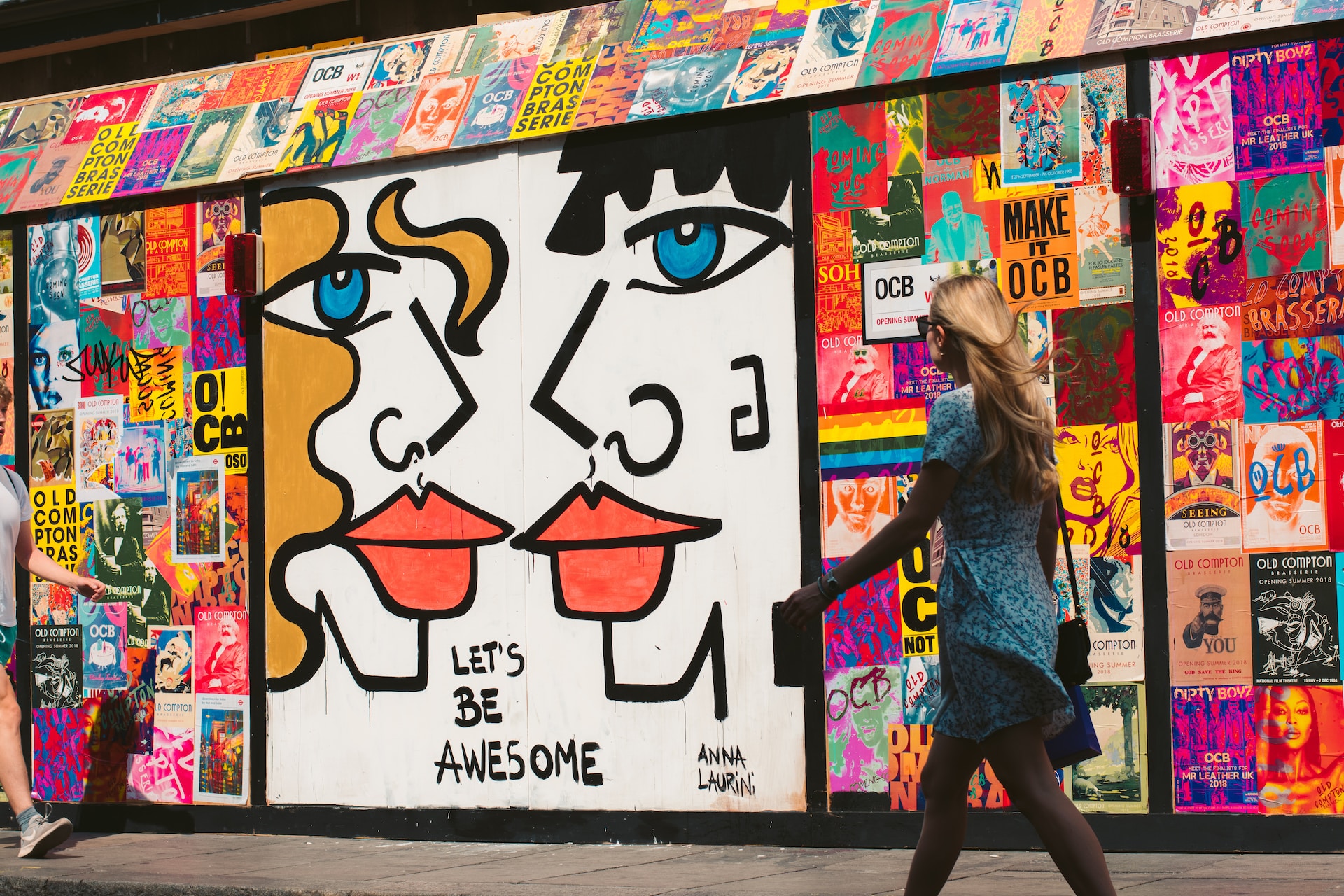
Photo by Mark Hayward on Unsplash

Thank-You for Making Your Broken Bird World

Yesterday I bid adieu to my Facebook wall and all the people who live there (for as long as I can, I think).

It felt really interesting to wake up this morning. That strange convolution was no longer tangled up inside my skull, cloaking my brain. What a strange thing not to realize every day for seven years.

So, maybe, it’s back to communicating the way I used to. The poem below is adapted from a letter to a friend I shall miss daily now, because Facebook isn’t bad, it’s just there and it makes using words easier than maybe using them should be.

Thank-you for Making Your Broken-Bird World

(For Nancy Anonymous)
Your land of broken birds is a set of 
427 switches 
So delightfully random yet crafted
As if out of scented wax, feathers, 
Star crusts and weed flowers. 
The effect of reading them is the same 
Effect you'd get in a deep forest 
When you find a lever on a tree 
That you click up and down really fast 
To the point where you don't know if it's 
Your eyes fluttering open and shut, or 
The whole world is flickering and you're 
The only one that notices 
Anymore/anyway 
Because, of course, the biggest problem 
In life is getting so used to things that go 
On and off people take them for granted
Or let them become boring, like love, it seems now,
Which is why I stand with my hand on the lever
Tonight
And why your work is so important. 
This is what you have called 
A Broken-Bird World. Right?

Bones of the Trade: An Argument for Pan-Human Poetics

Bones
Them Bones

All people are poets. Only some of us know this, but it’s true. Each person has these secret bones in them. This is pan-human. You need to know about these bones, though, to look for them, or you won’t know they’re there.

Text Bones are pulsing white aching things. When words come out of that special place that feels like something from the outside is coming in first, they lodge inside your Text Bones, which are everywhere. After a few moments, they can leave Continue reading

Teenage Wasteland: unanswered questions about the significance of music

For the past three decades I’ve been looking for novels and stories that illuminate the power of music. Rhythm linked with melody seems to go all the way to the depths of the human soul. This astonishes me. I have loved music all of my life. My father played every form of classical music in our house when I was growing up. And he played his music loud. By the time I was four it was profoundly comforting listening to everything from opera to string quartets or solo piano at volumes
well in excess of five on a hi-fi system. During the heyday of the audiophile in the late ’60s and early ’70s, my dad built himself a monstrous stereo system using state-of-the-art electronics and Scandinavian components.I got to hear Mahler and Tchaikovsky so loud and so pure they went all the way into me and moved me forever.

Pop music touched me early on as well. I fell in love with The Beatles by the time I was six (summer of 1964) and its been clear sailing since. In 1971 my older cousin introduced me to Elton John, Crosby, Stills & Nash, Cat Stevens, and Joni Mitchell. A close friend in junior high school turned me on to The Jackson 5 and Stevie Wonder. My 8th grade girl friend got me to listen to The Allman Brothers Band. And when my younger brother received The Grateful Dead’s Europe ’72 for Christmas in 1973 we were hooked forever on improvisational music and the idea that guitars, drums, bass and keyboards could be blues, jazz, rock, country, and even classical all at once. By the time my ears and brain fully grew to be able to integrate and differentiate sound simultaneously, it seemed to me that music was as much a connector to spiritual ecstasy and joy as it was mere entertainment or just something that might give one a reason to do the twist.

Our emotions at any given moment are like surfaces in the dimension of awareness that precedes language. The way I see it, when music reaches inside of us, when the spirit of sound filters and flows through our ears and skin, the vibration and integration of beat and melody and song in the depths (and shallows) of the listener has the potential to deeply color and touch that dimension.

Sometimes it seems to me that music is what allows us to most fully feel our souls, to know that we are able to feel the entire universe all at once. By soul I don’t mean some mystical or spiritual force. I simply mean the essence of who we are summed into the moment — whatever emotions we’re feeling; whatever ideas we’ve had up to that moment during the day; whatever knowledge we have about others and how others feel about us.Music, of course, has a way of lighting up other emotions, often complex. You feel one way when you listen to Beethoven’s 9th and another driving down the road blasting The Rolling Stone’s “Street Fighting Man” at full volume. If you love music and if you are able to let yourself go, you can’t not feel something.

But here’s a question that I ask myself often: how much of what I feel is what you feel? More important, maybe, how much of what I feel comes from what I bring to the music and how much is the song itself coming to me? The easy answer would be that most of what you feel, maybe all of what you feel, is what you bring to the music. It almost fully has to be that way…solipsists that we are, ultimately, whether we like it or not.

And yet, there is still that common equation at work when we are at a party all dancing to the same beat. Or consider a concert and that feeling you have during a particularly powerful performance — that electricity or current of … of what? … connection? groove? synchronic linkage? commonality? communion? It doesn’t matter if it’s the Christmas opera “Amahl and the Night Visitors,” or Carlos Santana plus a 15-piece percussion ensemble.

I search for evidence of these issues in the arts. I read interviews by musicians and performers looking for references to these questions. The ecstasy and release at a Bruce Springsteen concert is legendary. The networked single mind created by a Grateful Dead concert (and now Furthur) was the magic that drew so many of us into that world. And the ancient communal connections created by everything from tribal to Gregorian chant — and then beyond — was a central motif to experiencing the divine — and still is, if you are so inclined.

I seek evidence of this magic in literature and poetry. It’s not easy to find. The tendency is to externalize this magic or to reduce it to some basic stimulus-response/cause & effect explanation. If you are reading this, I fear, in fact, that somehow my words may come off sounding idiotically mystical, supercilious, or mixed up and reminiscent of Don Quixote jousting with windmills. That is not my intent. My concern here is to get at what I think is the real magic of being human. This same issue of psychic connection and emotional power is at the core of love, sex, good food, and dance. It is at the root of all aesthetic experience — from viewing a sunset or a beautiful painting to reading a poem, watching a comedian or a movie, or even just taking a long hot shower.


We move through life knowing that we should pay attention and take the measure of that which brings us pleasure. But all too often what we actually do is move too fast. We don’t behold the world with much wonder.Think about this! So much of human experience is beneath the surface and before language and thought. Aesthetic emotion is real and possibly the most important aspect of being human. I think of it as what constitutes our souls. I think of it as the magic and mystery that gives life its power. I also know that the soul of who you are, that thing that can be touched and colored by loud or soft music (and so much more) is what truly connects us to each other. It seems to me that this soul I define is our life force and our essence. It seems, too, that so few people really get this, so few people understand how grand and fantastic this power is.Either that or this is my own little musical fiction and I’m half crazy, and these unanswered questions about the human soul are just the musings of a mind lying to itself far too confidently for its own good.

And maybe that’s why it is so hard to find novels and stories that go to the heart of this. Some come close, but they don’t go all the way. Maybe, too, that is why it is so hard for people to get along in this world and why the default psychology of so many is cynicism, nihilism, hatred, fear, and hostility. With that, I sign off. I’m going to go listen to Led Zeppelin’s “Stairway to Heaven”at full volume, then The Who doing “Baba O’Riley.”

 
I don’t need to fight, to prove I’m right./I don’t need to be forgiven.

It’s only teenage wasteland.

___________________________________________

This issue is explored much further through story, myth, character, and metaphor in my novel, Beyond the Will of God. You can check it out in Amazon. (Click Pete’s name, above, to see a video he did connected to all of this).