Crazy new sounds and melodies consistently showed up on the radio for those of us growing up in the 1950s and 1960s (and on into the early 1970s). Every week or so brought astoundingly unique, creative, highly developed songwriting, production, and performance that constantly knocked our socks off…again, and again, and again. The record companies back then understood they could only partially make the call about what would work and what wouldn’t. Artists ruled. So did their listeners.
I still remember hearing “I Wanna Hold Your Hand,” in the first few days of 1964 right after it came out. I remember as well Elton John’s “Rocket Man” in April 1972, and “Sweet Caroline,” by Neil Diamond in May of 1969, both within the first day or two of release. And so many more. We were all sitting-duck virgins over and over again, sometimes on a daily basis, waiting for the latest by the performers we loved (and didn’t know we would come to love). DJs could be so artful with our pristine ears: “Here’s a new one from a guy we’ve never heard of named Don McLean. The song is called ‘American Pie.’ Weird name, but I think you’ll like it.”
So many first times to hear the latest by Smokey Robinson, Joni Mitchell, The Supremes, Neil Young, Sam Cooke, The Temptations, Chicago, Elvis, Aretha, etc. An endless orgy for our ears and our souls. So much variety. So much joy. The amplified electric sound of music. Such endless surprise! Honest to goodness real Magic!
Only a decade earlier, rock ‘n’ roll had started up (pop music as we now know it in general). Amplified sound and electric bass guitar had been mostly experimental post-war engineering projects by maverick inventors. Big band and orchestral music were the status quo methods of producing enough volume to fill concert and dance halls. Drum kits themselves had to be fairly basic for fear of overpowering other instruments in what were called combos.
But technology and Western forms of economy can be so profoundly transformative … and truly good news for every living person on the planet it turns out. Music is now, possibly, the quintessential art form for all of humanity here in the 21st century. Without doubt so many different forms – from rap, blues, and hip-hop to jazz, classical, and country – bridge cultural divides everywhere. I recall college debates back in the ’70s about which art form was becoming the most influential globally. We all feared that television was going to eclipse everything. We were wrong. Music has enveloped the prime interest of everyone on the planet. (Maybe that was always true and we just didn’t know it).
My History with the Sound of Music
My grandmother was a high school music teacher in the 1930s and 1940s. Her son, my father, growing up in that pre-rock era, had been a classical music aficionado who dreamed of a career as an orchestra conductor. He became a professor of social psychology instead, but played cello in a local collegium musicum. He’d also learned to play banjo during the folkie ’50s, and sang us to sleep with Americana songs every night during much of the 1960s. On car rides around the Midwest, we learned to sing ”Shenandoah,” “Oh! Susanna,” “This Land is Your Land,” and “John Henry,” at the top of our lungs (in partial harmony). Our family favorite was “Green Grow the Rushes, O,” a call and response English folk song built out of cumulative verses counting certain odd poetic things from “twelve for the twelve apostles,” to “one is one and all alone and evermore shall be.”
I may have had music all around me from the time I was born, but I was never adept at playing an instrument (or practicing…even just pathetically). I stumbled through trombone, piano, and cello in serial fashion, and managed to give up it all up around the time I turned 13 (although, of course, I couldn’t help playing my tennis racquet to songs by The Monkees and Herman’s Hermits).
Somehow, though, in my late teens, I managed to learn the rudiments of guitar thanks to a close friend who was a one-in-a-million “pick up my axe and rock out” genius. I never took lessons, really, or even practiced. We just messed around learning chords to all the songs of the day (thank you Neil Young in particular), but we also figured out that something amazing happened when you paid close attention to loud guitar music, especially, for some of us anyway, when you were in certain frames of mind listening more fully than usual. Also, actually playing loud guitar in bands, jamming with friends, or even alone in basements could be even more fun than simply listening.
Questioning the Sound
I needed to know what the heck was happening. Why and how, for instance, was I so damned blown away during that one full moon summer night when I was 16 listening to Jimi Hendrix play “Red House” over and over again? I just couldn’t get enough. I’d become fully open to the freedom and inspiration of the loud, electric sound of music – especially improvised instrumental (sometimes vocal) guitar-centric jams.
That’s all right, I still got my guitar…
And for that matter, why were so many people clamoring to understand the mental substrait of mind-altering drugs, and yet more or less thoughtless about the impact of music on the collective consciousness of our culture? It was never about listening to someone expertly whistle “Dixie,” but it’s kind of been treated that way in this modern Western world for decades now.
Obviously, a lot of people (musicians, choir directors, and DJs at least) have always understood that there’s profound human power connected to every kind of music. But no one really understood how far it all goes, or what the potential might be. We say, music soothes the savage beast. But how? And why?
And by not acknowledging how important that soothing may well be, how much are we missing out on understanding the true power of our minds, especially the full breadth of the unconscious and the real magic of creative perception we each possess?
Lighting Up
Us Boomers may have started out in the beginning simply floating on the surface with “Hound Dog,” “I Want to Hold Your Hand,” or “You Send Me,” but once we graduated to “Smoke on the Water,” “Riders on the Storm,” “Hot Summer Day,” “In-A-Gadda-Da-Vida,” “Truckin’,” and “Whole Lotta Love,” it felt like we’d arrived on a supra-human level of unexplored limbic awareness and an impending, profound “something” (I am aware of how silly that sounds, but it was the truth). Certainly rock ‘n’ roll was not just a simple form of romantic sensory confection.
That was my experience anyway as I grew up.
I’m pretty sure most every one of us has had some form of epiphany at one point or another listening to music we love. For a lot of us that epiphany can be a life-changing moment. Yes, sometimes it was drug-related, but often enough it was just part of being a creatively inclined human being who happened to be a teenager. You felt you’d been touched by an inner world of infinite emotional connection, a truer version of the Self.
A strange musical intelligence seemed to have been locked up in our brains that we were learning to release. The bar was raised for what it meant to be alive on earth in every moment of every song, listening with each other or by our selves (Note: this, for me, was mostly in the time before headphone ubiquity).
Sound Effect Infinity?
Researchers have come a long way over the past three to four decades in mapping consciousness and understanding how our brains react to song. A good deal of laboratory work has shown that the parts of the brain that light up when people are having a conversation with each other also light up when people listen to music – all the regions of the brain exactly, except the part that assigns definitions to words.
Music is still, of course, about communication and meaning, but it would appear that it is more about emotional communication with the self than the semantics and syntax needed to speak with others. The implications of that research seem pretty important, not because of what it shows us about music, but because of what it shows about the effect of sound on human emotion – or maybe more importantly, the effect of sound on the human unconscious mind, which is always swimming with emotion and talking to itself about the full meaning of things whether we know it or not.
So, yes, music can be like candy, aural confection of sorts, and there are dozens of different musical treats we have to choose from every time we lock into our phones or our laptops–rock, punk, choral, rap, pop, electronica, jazz, bluegrass, chamber music, metal, reggae, opera, hip-hop, blues…
It all gets us high one way or another. But there is so much more than a buzz going on in there. The occasional goose-bump or two is not a simple sentimental tick. We need to think a bit more creatively about what impact song and groove and melody have on us. If you know who sang: “I’m a dweller on the threshold/ And I’m waiting at the door,” then you may well know what I’m talking about.
Sometimes I wonder if I’m delusional and still lost in psychedelic “insight” impossible to escape. Or maybe it takes being a musician to sense the questions I’m posing. Whatever. I’ve been playing guitar now for over 50 years, mostly behind closed doors and by myself (I’m not proud. Sloppy guitar playing is a good way to always have goals).
That said, I am still constantly stunned at how deep music-making takes me into my Self and how easy it is to get lost in the world of tone and sound and harmony and rhythm. Now that I’m writing novels for a “living,” I play guitar every day, often several hours in the afternoon. It takes about 20 minutes of warming up, but all of a sudden, somehow, gates of thought and emotion open up to me, I am transfixed by what I’m doing. At times it feels like I’m ported into another dimension. Time disappears. Or, rather, time changes from something happening to me into something happening to the music I’m making.
I’m also stunned that I’ve been able to listen to the same songs by Jimi Hendrix or the Beatles or Jeff Buckley or Miles Davis (and so many others) over and over through time. Going back to the Beatles, we’re talking 62+ years. I’m still touched deeply in places that I don’t fully understand: chills, feeling pumped up, energized by more than two cups of coffee, dancing foolishly in my office chair, open-minded on a new frontier of thought sometimes, crazy-questioning everything people think is normal.
I’m sure I will die still wondering about all of this, grateful to have lived in the shadow of the somewhat early days of rock ‘n’ roll and to know how far we’ve come; to know as well we will always be heading down new tributaries and creeks and rivers towards an ocean that’s been there from the beginning of human existence.
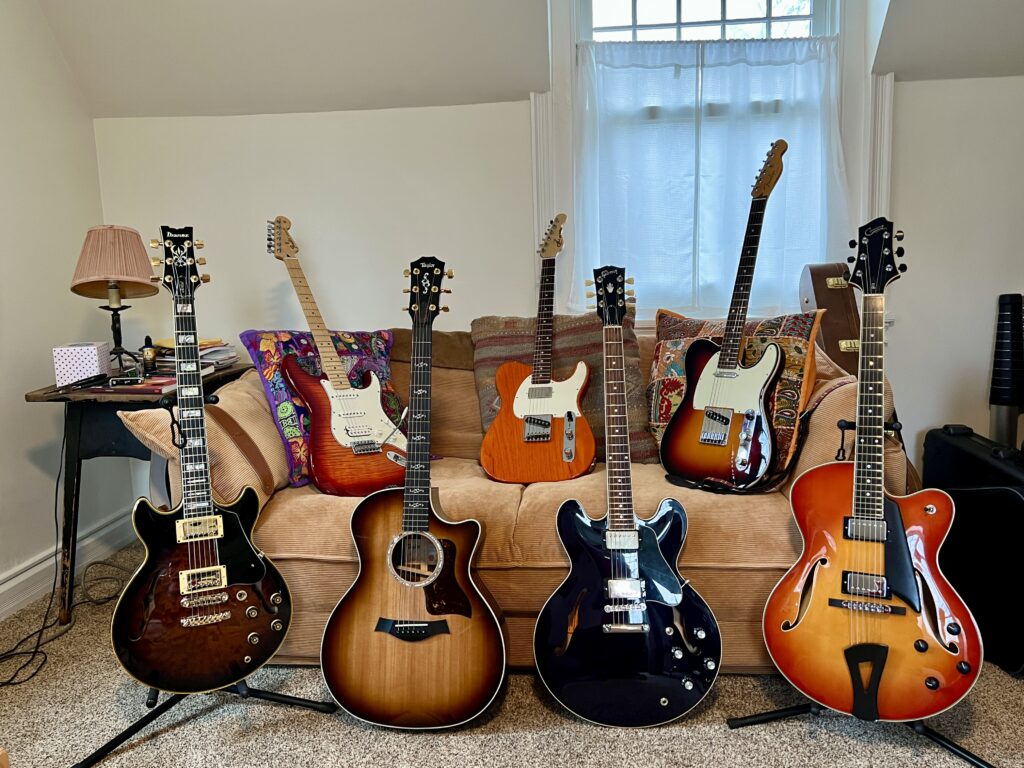
Those are my thoughts, anyway, this morning. What do you get out of music? How deep does it go in you? Comment below or send me your personal thoughts… (And, yep, those are my guitars in that photo and everyone of them is my favorite).
And the quote about being a dweller on the threshold? Van Morrison. Van the Man:
“I’m a dweller on the threshold
But I cross the burning ground
I’ll go down to the water
Watch the great illusion drown.”