Special Note from the Future: My new novel, Sound Effect Infinity, should have been available as an E-book everywhere that digital books are sold, but it wasn't until now, here in 2026. Here's the landing page at Amazon now and for the rest of the spring of 2026. Below is text from 2025. I have moved quite far since then. This is left here at my website for archival purposes only. My old publisher never really got things rolling for me, so this year (2026) we moved forward with Flat Branch Press. Below, you’ll find where I was in 2025 if you want some background on where I was in 2025. Where were you, by the way?
As to the spoken word version, I continue to slowly edit and correct the audio files. What an interesting and important process for all writers. I pointed that out in my last post. It continues to be a fascinating experience to hear someone else read my narrator’s words. Instead of revising and editing, the point is to ensure that they are replicated into voice as close to how they were written as possible. I’m hoping we’ll all see the audio version for sale by the end of March.
I wish the bound and printed version of this novel was already available, but the E-Book will have to do for now. I can breathe better with at least one version of this funky story out there. For those of you who “only read on paper,” may I suggest getting started on the E-book then converting over when it comes out in premium hardcover? Just a thought. Your support now will help immensely with internet algorithms when the printed version becomes available.
No matter what, I had been waiting far too long for any version release of Sound Effect Infinity. Yes, in part it’s a near-future science fiction dealing with the power of loud guitars and the magic of music all connected to secrets about CIA paranormal experimentation and remote viewing. But it’s also now kind of close to home in how it describes the way America’s political life seems to be floating off into strange new sections of our national cosmic river.
For the record, Sound Effect Infinity began as an attempt to write something intelligent but wild and crazy about sex, drugs, and rock ‘n’ roll. So many whippersnappers out there still give my generation shit with their “Okay, Boomer…” assholery. But think about it: who invented sex, drugs, and rock ‘n’ roll as a philosophy and a way of life? And who now is inventing this bizarre shift of intelligence in our collective life here in the mid-2020s?
Boomers Rock Better Than Ever
As to that sex, drugs, and rock ‘n’ roll phenomenon, I turn 67 in a few days and have been asking myself over the past several years: “Would I go back and do things differently?” I want to believe I would. No question, you can never have enough sex when you’re below the age of 30, but the drug thing was rather debilitating after maybe that first 24 months or so in my teens. By my junior year of college, I had fully weaned myself off getting high every day by substituting whiskey highballs on Friday and Saturday nights only. But that’s still getting high, to be honest, and that habit rolled along first morphing into a regular, nightly unwinding (during the Reagan era) and lasting until I turned 50 when I finally understood the problem for what it was and began the long process of freeing myself from what really is a useless and emotionally poisonous addiction. It would take more than a decade to fully escape that prison.
So, yeah, booze can (and will) fuck you up. Not just as a drunk or functioning alcoholic, but in chronic emotional ways you aren’t even really making the right connection with. I may have written this in other places, but every counselor talking to couples in need of therapy should start by asking both parties to stop drinking and/or getting high in any way for a month before they come back for their second session. Sorry. But that’s totally true. Me? I’ve been 100% free of any kind of buzzy mindshift since November 2022.
As to the rock ‘n’ roll side of things, my generation gets an A+. No debate. Sorry. Music with a beat is now, in fact, one of the principle art forms worldwide, and by far and away the most personal and intimate sensual experience almost everyone has on a daily basis everywhere on the planet.
If you’ve learned the importance of the beat, you don’t even need to hear music in order to move in time to the Universe at large. One of the most touching video clips I saw on Instagram last year was three young boys, maybe 8 – 10, break dancing with joyous abandon in the middle of Gaza rubble. Bizarrely, the American press didn’t do a good job of covering this, but here’s an Australian outlet’s coverage of the phenomenon: This breakdance crew in Gaza is using dance to help children heal from trauma.
Rock music is in everything now, even what people call classical. And don’t get me wrong, Boomers didn’t invent rock. No one did. It probably came out of the ground first, but was in the air as well by 1948 or so, first, in places like New Orleans, Kansas City, and Chicago, but spreading fast everywhere – from London to Tokyo to Rio de Janeiro to Lagos to Dublin by 1962.
What Do You Think, Though?
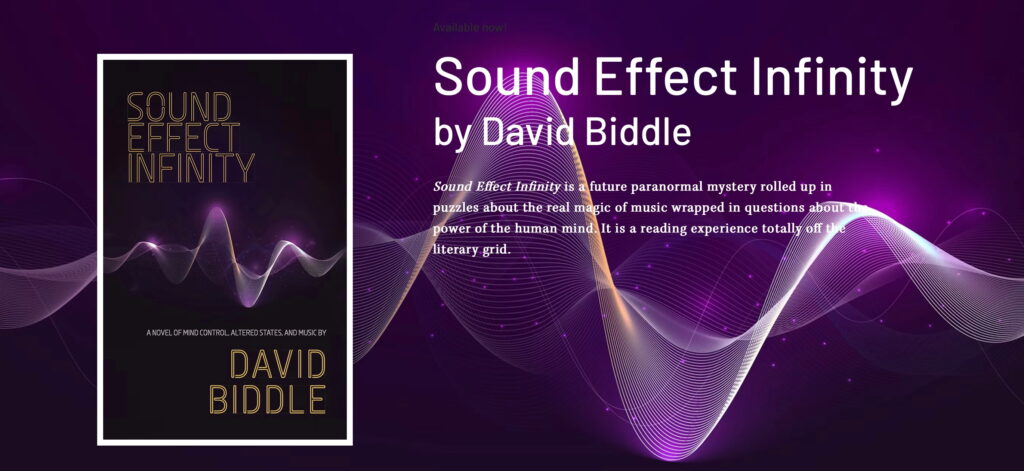
Book promotion is going to be a major part of my 2025. The E-book edition of Sound Effect Infinity [was available but is available here in 2026, now, as a hardcover at Amazon…have I said that yet?]. Maybe it’s a new take on sex, drugs, and rock ‘n’ roll, maybe not. You’ll have to check it out.
Thus, here in the beginning of 2025 I’m partly sitting around waiting for people to read Sound Effect Infinity and tell the world what they think. Partially waiting as well for the hardcover release. Also hoping folks will just step up impatiently and buy the E-book while pre-ordering a copy of the printed version. You won’t be charged for that hard copy until it ships.
Next Book Up Is?
While I wait, I’m hard at work still on my next project, code named Notes on the Golden Country. I am up to the third and final section of that book which is part quest, part historical fiction, and part time travel science fiction. As with Sound Effect Infinity, this story is off the beaten path in all sorts of ways. I think it’s safe to say that as a kid who grew up in the ’60s and ’70s I’ve never found much value in canned or predictable attempts at storytelling. Notes on the Golden Country is all about America and somewhat rebellious in its plot and theme. (Is being rebellious an American trait?).
My writing has been kind of twisted into knots after last year’s election. I was surprised to see a majority of voters put the Republican Party in charge of this country. That still doesn’t compute. The choice was between love on one side and punishment on the other. Now it seems like it’s between dismay and destruction. Somehow, I’m finding ways to rise beyond all this shit. I have special secrets I’ve figured out and ways to avoid stepping in the piles of shit that are currently being dumped all over America by this group of foolish, incompetent wannabes.
Note that it was the majority of actual voters that put the Republicans in a position to shred government services and support, i.e., people who went to the polls. The reality is that the largest percentage of eligible voters did not vote. Once again, the winner of our national election was people who don’t understand or don’t think they should be required to give a shit. That wasn’t a surprise, but it was very sad since it was pretty obvious that a certain segment of political types have made it their business to suppress voting behavior and limit access to the polls. When people make things that obvious and are so openly cynical about what they’re doing and talk hatred, division, and punishment, it’s kind of a good idea to show them they’re being jerks at least by casting a vote on whether you agree or want a bit more common sense and humility leading the way for us all.
Looking People in the Eyes
I just finished writing an essay this afternoon that will be published soon. Near the end of it, I wrote: “I believe in peace, love, community, independence, laughing, looking people in the eyes, being honest, and working hard not to be angry or hateful towards anyone.” I try to get those perspectives into all of my work as best I can–my stories, social media posts, online commentary pieces, and the lyrics to music I’m working on. I have one song I’m almost happy with these days called “Discontented People,” and another called “Modern Crow Blues.” Also, I have the music fully composed but not the lyrics to a song I have decided to call “Dinner in the Air.” There are a lot of other ones in various stages of undress. I try to work on them carefully because I don’t want anger (rage?) guiding what I’m doing. Hopefully, those songs can actually be recorded and sent out into the world by this fall. Some of them are kind of good…or at least I’m happy with them. Happiness is important these days, right? Something to share? Buy the book and you’ll make me even happier…
I’ll leave off here now with a small quote from Sound Effect Infinity:
Even now, he gets inside each one of us. We feel it. We hear it. He moves us. But we don’t really think about what’s happening. It seems normal. Sound and feeling. Loud reverb music finds the actual human soul that each of us has whether we believe in that kind of thing or not.
Chapter 3: That’s All Right